Wednesday, July 07, 2004
Alive: the reflection paper part IV
The people of God were also alive and well right in our bus. Our group was an intense one—we had intense conversations, intense learning, and intense fun. As we learned about one another and our respective traditions, I could sometimes feel the ecumenical relations improving. We worked together to translate Greek inscriptions on mosaics, to remember the Hebrew we learned and turn it into something approximating modern Hebrew, to do water ballet in the Dead Sea, to climb thousands of stairs—and to get down again! I struggled quite a bit with my sense of call to Scotland—where I was supposed to go in September—and my colleagues helped me think through that and make a decision consistent with what I felt led to do. Friendships developed that could truly last—once people have traveled together they really know what their friends are like! We truly developed a Christian community: we ate together, worshipped together, worked together, traveled together, lived together, had fun together, were serious together, prayed together. We helped each other along in the hard places, shared our resources, and pined after pizza. And as we traveled these places, met people, and shared experiences we processed our thoughts and our vision, and carefully thought through some things (and the theology) we thought we knew, and many of us learned to discuss or even defend our position without getting defensive—a crucial skill for the church. Each person contributed something incredibly valuable to the whole experience for me—whether in knowledge, excitement, or personability. I spent much time wondering what I would contribute to the group, but I have realized now that it may not be the same for each person. What others contributed to my experience may not be what they contributed to my roommate’s experience, even. As a group, however, I think we learned how to be the church—the community of God’s people who live together in spite of their differences, loving one another as Christ loved us.


Sunday, July 04, 2004
Alive: the reflection paper part III
Of course, the places of worship often expressed the centuries of the faithful in several ways, as did our experiences in them. The Umayyad Mosque in Damascus has been a pilgrimage site for hundreds of years, and was one of the busiest and most active religious sites we visited. Shoeless people, many covered from head to toe (some even with their faces completely covered), walking about, praying, visiting the shrines for the heads of important people (John the Baptist and Ali both supposedly left their heads in Damascus), or just resting in the cool of the sanctuary. The church at Gethsemane has purple cross stained glass windows, amazing mosaics and a dark and somber feel echoing the events on its ground of nearly 2000 years ago and the attitude with which most people approach those events. The church I came to call the “Jesus Wept” church, with its teardrop design and the Korean group singing “What a Friend We Have in Jesus” as we arrived, and our group singing “Amazing Grace” as a few other random tourists joined us, singing as we looked out the window at the Old City of Jerusalem and the golden Dome of the Rock. The Church of St. Anne with its high ceilings, amazing acoustics, and our voices being lifted up as we sing the Doxology to the tune Old Hundredth—words billions have sung over the ages, a tune made for that space—a holy thrill. Both the Church of the Holy Sepulcher and the Church of the Nativity, witnessing to the too-old schism between churches/denominations, and also to the possibility of sharing and relationship between those of differing theological histories and worship styles. St. Katherine’s Monastery, with a mosque minaret next to its belltower, showing the world that peaceful coexistence can be more than just a dream. Each of these places gave voice to the church through the ages. They marked our way as we traveled these places we’ve read about and helped us fit ourselves into the divine-human narrative. The people of God, in every tradition, in every time, and even in every place, were especially alive for me in these spaces.
...
...
Friday, July 02, 2004
The Sea of Galilee

The Sea of Galilee, from the Gentile side looking over at the Jewish side (as they would have been in Jesus' day).

The Wilderness of Sin(ai)
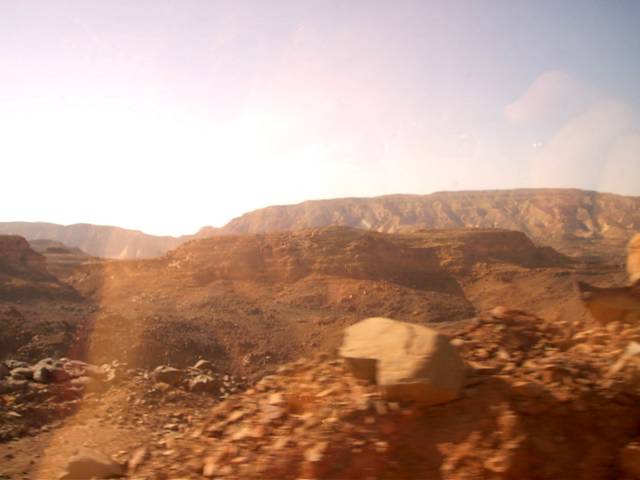
The Wilderness. As in Exodus wilderness. It was hot and all looked the same. Understand the 40 years?
Castle!
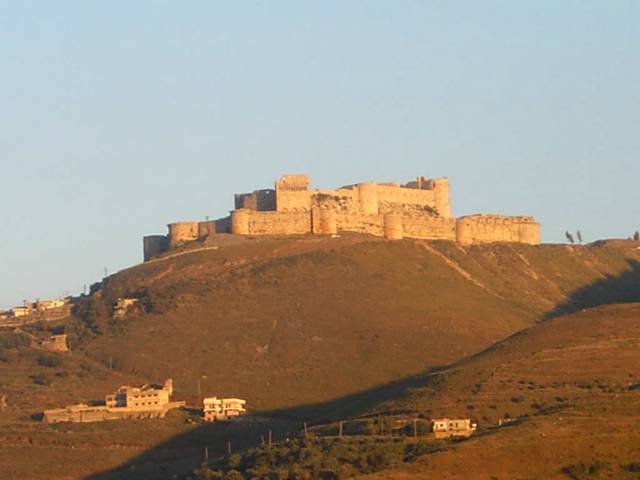
Crak de Chevaliers: a Crusader castle. The coolest Crusader castle. Here we're looking at it from my hotel room. Super super cool inside too--stables and wells and big rooms and ovens and places to pour boiling oil on invaders...yeah.
Alive: the Reflection Paper, part II
As the historical record took on flesh, I found that another thing alive and well was the cloud of witnesses. Those who have gone before us in faith, and those who are alongside us in a different path of faith, were everywhere we looked. Since returning, I haven’t been able to open the Bible without exclaiming (usually aloud, even in church—much to the dismay of my fellow pew-dwellers) “I’ve been there!” or “I’ve seen that!” As we traveled in Damascus, Hama, Aram, Edom, Sinai, to Mt. Carmel, to Mt. Nebo, to the Sea of Galilee and Jerusalem, the communion of saints was practically palpable. We walked where Paul walked. We explored a city Isaiah prophesied against. We stood where Moses stood and looked into the Promised Land. We explored the city John the Baptist may have known. We climbed the mountain of Moses and we looked down on the valley from the place where Elijah beat the prophets. We saw Peter’s house and a city and synagogue Jesus would have known, we worshipped on the Mount of Beatitudes. We looked at the spring Mary drew water from, we visited Herod the Great’s cities, we saw the birthplace and the tomb of Jesus. Whether or not any of these traditional sites is indeed the historical place almost doesn’t matter—what matters is that for thousands of years (or at least a thousand and a half) people have thought it was the place. For thousands of years people have come to pray and to worship, to see the place and take back an experience of the living God. For me, the important thing wasn’t touching the hole where the cross may have stood, but praying in a place where millions of people have prayed. It wasn’t about whether Jesus was buried in the cave in the Church of the Holy Sepulcher or the Garden Tomb, it was about the thick cloud of witnesses in the place (no, that wasn’t just incense!).
In some cases, it was also about experiencing something that probably hasn’t changed much through the centuries. The high place at Petra forced me to understand how important sacrificing in a high place was—it was nearly 800 steps up, and had a view of the whole city and was clearly the best place for worship involving sacrifices—it’s high and unobstructed so the smoke could rise to the heavens. When they say “the high place” they mean literally high! Important sacrifices required a lot of effort, it wasn’t just a casual undertaking. Those 800 steps probably weren’t there at first, and carrying a live animal up there would have been hard work—I wasn’t sure I could even carry myself up there. The climb up Mt. Sinai was hard, even given that we rode camels halfway up (which, by the way, was one of my favorite things!). No wonder Moses was so irritated that he had to go up again and again. The wilderness of Sinai looks like the kind of place one could get lost in. The Promised Land does look awfully good after that wilderness, too! The Sea of Galilee could easily have a quick storm that would swamp one of those little boats, and it takes a deceptively long time to cross. Not much of the experience of some of these places has changed—often just some stairs, or a new town in the valley, or a boat with a roof on the back make it clear that we are in the 21st, not the 1st, century.
...
In some cases, it was also about experiencing something that probably hasn’t changed much through the centuries. The high place at Petra forced me to understand how important sacrificing in a high place was—it was nearly 800 steps up, and had a view of the whole city and was clearly the best place for worship involving sacrifices—it’s high and unobstructed so the smoke could rise to the heavens. When they say “the high place” they mean literally high! Important sacrifices required a lot of effort, it wasn’t just a casual undertaking. Those 800 steps probably weren’t there at first, and carrying a live animal up there would have been hard work—I wasn’t sure I could even carry myself up there. The climb up Mt. Sinai was hard, even given that we rode camels halfway up (which, by the way, was one of my favorite things!). No wonder Moses was so irritated that he had to go up again and again. The wilderness of Sinai looks like the kind of place one could get lost in. The Promised Land does look awfully good after that wilderness, too! The Sea of Galilee could easily have a quick storm that would swamp one of those little boats, and it takes a deceptively long time to cross. Not much of the experience of some of these places has changed—often just some stairs, or a new town in the valley, or a boat with a roof on the back make it clear that we are in the 21st, not the 1st, century.
...
Thursday, July 01, 2004
Alive: the Reflection Paper, part I
Alive
Teri Peterson
Columbia Seminary, Decatur GA
As our group gathered in mid-May for the first time, many were worried about taking this trip this year. Some had already withdrawn. Some thought about it, and one didn’t come back for our second day of orientation. Would it be safe? Our friends and families prayed that we would come back alive; we prayed that we would be a good group and that we would learn a lot. Both prayers were answered!
From the moment we landed in Damascus until the moment we returned to Atlanta (or for some, wherever else they flew on to) we seemed to go non-stop. The many hotels, bus rides, 7am wake up calls, “short five-minute walks,” and endless meals of hummus were part of our daily routine. Also part of our daily routine (which wouldn’t have been routine anywhere else, or with anyone else!) were ruins. So many Bronze Age/Roman/Byzantine/Crusader ruins, so little time. We explored these tells, these ancient civilizations. We learned history, archaeology, culture, and more. Imaginations came alive as we pondered what life was like in Apamea. What was it like when part of daily life involved walking on a mile-long colonnaded road, bustling with carts and people? What was it like to daily feel dwarfed by the several-story high columns? And then, what was life like for the archaeologists who found a whole city buried under a meadow and began to “reconstruct again” (as Walid would say) the sparkling white colonnade? The very place was alive with those who had walked the same Roman pavement before us.
History itself came alive for me when we visited Crak de Chevaliers. My courses in the Crusades served me well as I recalled Raymond of Giles and his armies and successors taking this castle and holding it even against Saladin. Walking the corridors where hundreds of years of life had taken place was truly breathtaking, as was the view. People had lived and died there, poured hot oil on invaders, ridden horses in the hallway, hidden behind the safety of slanted walls and a moat, admired the view, expanded the castle, lived in its walls, and been asked to leave by the government’s historical preservation interests. Amazing.
Imagine life in a city carved out of the mountainside, with bright watercolor-type streaks and swirls lining your walls and ceiling. Imagine attending plays in theaters with perfect acoustics. Imagine living in a ruined city, adding your own layer to the thousands of years of life below. The several thousand years of civilization in these places still lives today, in ruined cities, in art and even writing, and in the people who continue to go about everyday life in the places tourists flock to.
...
Teri Peterson
Columbia Seminary, Decatur GA
As our group gathered in mid-May for the first time, many were worried about taking this trip this year. Some had already withdrawn. Some thought about it, and one didn’t come back for our second day of orientation. Would it be safe? Our friends and families prayed that we would come back alive; we prayed that we would be a good group and that we would learn a lot. Both prayers were answered!
From the moment we landed in Damascus until the moment we returned to Atlanta (or for some, wherever else they flew on to) we seemed to go non-stop. The many hotels, bus rides, 7am wake up calls, “short five-minute walks,” and endless meals of hummus were part of our daily routine. Also part of our daily routine (which wouldn’t have been routine anywhere else, or with anyone else!) were ruins. So many Bronze Age/Roman/Byzantine/Crusader ruins, so little time. We explored these tells, these ancient civilizations. We learned history, archaeology, culture, and more. Imaginations came alive as we pondered what life was like in Apamea. What was it like when part of daily life involved walking on a mile-long colonnaded road, bustling with carts and people? What was it like to daily feel dwarfed by the several-story high columns? And then, what was life like for the archaeologists who found a whole city buried under a meadow and began to “reconstruct again” (as Walid would say) the sparkling white colonnade? The very place was alive with those who had walked the same Roman pavement before us.
History itself came alive for me when we visited Crak de Chevaliers. My courses in the Crusades served me well as I recalled Raymond of Giles and his armies and successors taking this castle and holding it even against Saladin. Walking the corridors where hundreds of years of life had taken place was truly breathtaking, as was the view. People had lived and died there, poured hot oil on invaders, ridden horses in the hallway, hidden behind the safety of slanted walls and a moat, admired the view, expanded the castle, lived in its walls, and been asked to leave by the government’s historical preservation interests. Amazing.
Imagine life in a city carved out of the mountainside, with bright watercolor-type streaks and swirls lining your walls and ceiling. Imagine attending plays in theaters with perfect acoustics. Imagine living in a ruined city, adding your own layer to the thousands of years of life below. The several thousand years of civilization in these places still lives today, in ruined cities, in art and even writing, and in the people who continue to go about everyday life in the places tourists flock to.
...
at last
ok, i've been getting requests to hurry up with the "how was it" post. here you go.
It was great.
Sunny. hot. a lot of walking and climbing. intense. lots of learning. more roman columns than you've ever seen (unless you happen to have been there, in which case, approximately exactly the number of roman columns you have previously seen. probably more than in rome.). great times walking with Paul and Moses and Jesus, etc. except on water. none of us had the guts to test out the "walking on the Sea of Galilee" option--we stayed in the boat. lots of great people. lots of cool places. lots of hummus. lots of craving pizza and Dr. Pepper. lots of horrific things to see, like the Wall in Palestine, the state of Bethlehem, the bulldozing of olive trees, etc. lots of great things, like children playing in Damascus, people visiting churches, the 6th-century (never destroyed!) church of the nativity, the Palestinian Christians who were so happy to see us that they opened not one but two shops for us in Bethlehem, etc. Also cool: the Parthenon. just saying.
Anyway, it was an amazing trip. I learned a lot of history and met a lot of really great people. Made some good friends. Learned a lot about myself. Had some "holy thrills" like singing in an acoustically perfect church, looking at the Promised Land from Mt. Nebo, worshipping on the Mt. of Beatitudes, etc. I came home tan and fit, and with a great sense of the people. It seems that the Arab countries are hopeful. Unfortunately, Israel/Palestine doesn't have much hope. In fact, I came home feeling rather like many of the people I talked to there, who are quite hopeless about the situation and don't see how there can be peace in their lifetime. As Shirley Guthrie says in Christian Doctrine, however, our only hope is in God, not in ourselves. So there you go.
I'll be posting my paper here shortly. It's five pages, single-spaced, in Word. I'll put it up a section at a time. Enjoy. Also, I'm putting a link over there <--- on the left to My Yahoo Photos. 287 photos of the trip. Enjoy!
It was great.
Sunny. hot. a lot of walking and climbing. intense. lots of learning. more roman columns than you've ever seen (unless you happen to have been there, in which case, approximately exactly the number of roman columns you have previously seen. probably more than in rome.). great times walking with Paul and Moses and Jesus, etc. except on water. none of us had the guts to test out the "walking on the Sea of Galilee" option--we stayed in the boat. lots of great people. lots of cool places. lots of hummus. lots of craving pizza and Dr. Pepper. lots of horrific things to see, like the Wall in Palestine, the state of Bethlehem, the bulldozing of olive trees, etc. lots of great things, like children playing in Damascus, people visiting churches, the 6th-century (never destroyed!) church of the nativity, the Palestinian Christians who were so happy to see us that they opened not one but two shops for us in Bethlehem, etc. Also cool: the Parthenon. just saying.
Anyway, it was an amazing trip. I learned a lot of history and met a lot of really great people. Made some good friends. Learned a lot about myself. Had some "holy thrills" like singing in an acoustically perfect church, looking at the Promised Land from Mt. Nebo, worshipping on the Mt. of Beatitudes, etc. I came home tan and fit, and with a great sense of the people. It seems that the Arab countries are hopeful. Unfortunately, Israel/Palestine doesn't have much hope. In fact, I came home feeling rather like many of the people I talked to there, who are quite hopeless about the situation and don't see how there can be peace in their lifetime. As Shirley Guthrie says in Christian Doctrine, however, our only hope is in God, not in ourselves. So there you go.
I'll be posting my paper here shortly. It's five pages, single-spaced, in Word. I'll put it up a section at a time. Enjoy. Also, I'm putting a link over there <--- on the left to My Yahoo Photos. 287 photos of the trip. Enjoy!
Tuesday, June 15, 2004
home
I'm home now. recap, review, and reflection on the trip, forthcoming. for now: sleeping. in my bed. for more than one night in a row. yay!
Saturday, May 29, 2004
Taba, Egypt (in the Sinai)
(written afternoon of Friday 28 May, before i got to the internet cafe)
Things i had not done 15 hours ago but have done now:
1. Had a wake-up call in a hotel at 1.30am
2. Ridden a camel.
3. Climbed a mountain in the middle of the night.
4. Watched the sun rise from the top of Mt. Sinai.
5. climbed down a rock-slide that was supposedly stairs.
6. eaten an egg and cheese "omelet" prepared at a slightly sketchy but still "best-available" hotel in Egypt.
7. Bought my way into a closed monastery. (in all fairness, our leader bought the whole group in so I didn't actually do this, but still...)
8. Seen pages from the Codex Sinaiticus, a 4th century manuscript of the Bible, one of the most reliable manuscripts we have.
9. stayed in a resort with a pool complex but the jacuzzi not working.
10. looked out my hotel window and realized i was looking at the border between Egypt and Israel.
Tomorrow we head into Israel. Yay! The land of Jesus awaits. I can hardly wait to float in the Dead Sea, explore Galilee, and hang out in jerusalem. :-)
Things i had not done 15 hours ago but have done now:
1. Had a wake-up call in a hotel at 1.30am
2. Ridden a camel.
3. Climbed a mountain in the middle of the night.
4. Watched the sun rise from the top of Mt. Sinai.
5. climbed down a rock-slide that was supposedly stairs.
6. eaten an egg and cheese "omelet" prepared at a slightly sketchy but still "best-available" hotel in Egypt.
7. Bought my way into a closed monastery. (in all fairness, our leader bought the whole group in so I didn't actually do this, but still...)
8. Seen pages from the Codex Sinaiticus, a 4th century manuscript of the Bible, one of the most reliable manuscripts we have.
9. stayed in a resort with a pool complex but the jacuzzi not working.
10. looked out my hotel window and realized i was looking at the border between Egypt and Israel.
Tomorrow we head into Israel. Yay! The land of Jesus awaits. I can hardly wait to float in the Dead Sea, explore Galilee, and hang out in jerusalem. :-)
Wednesday, May 26, 2004
Petra, Jordan
I have just climbed about 2000 steps and seen some of the most beautiful views of the world. amazing. Petra is the "rose red city" because the sandstone is rosey colored. but it is also yellow and white and gray and blue and black and pink and all kinds of colors--I sound like Joseph and the Amazing Technicolor Dreamcoat. but it's true. it looks like a watercolor. but my legs are still tired!
I don't have much time, but the update is: I like Petra, here where supposedly Moses struck the rock and water gushed out. and tomorrow we head toward Sinai. tomorrow night we climb Jebel Musa, which is traditionally considered to be Mt. Sinai (you know, Moses and the ten commandments). There is camel riding involved in this, which I find very exciting. :-)
y'all be good until I get back!
I don't have much time, but the update is: I like Petra, here where supposedly Moses struck the rock and water gushed out. and tomorrow we head toward Sinai. tomorrow night we climb Jebel Musa, which is traditionally considered to be Mt. Sinai (you know, Moses and the ten commandments). There is camel riding involved in this, which I find very exciting. :-)
y'all be good until I get back!
Monday, May 24, 2004
Amman, Jordan
I've just finished a week in Syria, which was AMAZING. Lots of great people, big cities, desert, nice hotels, good food, shopping (but I've not bought anything!), mosques, castles, and roman ruins. lots of roman ruins. in fact, so many that they look very similar to me right now and therefore I am no longer taking photos of roman ruins that all look the same. differences that make the ruin: what are the columns made of? (some from Egyptian granite brought here from Aswan. some from marble. some from local stone.) how many temples? to whom? are there churches? is the stone white, red, or black? do people still live there? how long has it been an important site? (since the bronze age, or only since the bce/ce switch?)
In any case, we've looked at a lot of ruins. a lot. and there are more coming. but this weekend: climbing Mt. Sinai!! with camels!! then we swim in the Dead Sea! And on to Jerusalem, then a day at a resort island in Greece, then home. it sounds so quick, but it's two more weeks.
Amman is nice so far. Jordan is supposed to have great jewelry. we'll see if I come home with any. I'm trying to curb my materialism, so I've only bought postcards--which means i don't have to take as many pictures! we'll see how that goes.
anyway, that's all for now. good times in the middle east, where it's hot and we eat hummus twice a day. :-)
In any case, we've looked at a lot of ruins. a lot. and there are more coming. but this weekend: climbing Mt. Sinai!! with camels!! then we swim in the Dead Sea! And on to Jerusalem, then a day at a resort island in Greece, then home. it sounds so quick, but it's two more weeks.
Amman is nice so far. Jordan is supposed to have great jewelry. we'll see if I come home with any. I'm trying to curb my materialism, so I've only bought postcards--which means i don't have to take as many pictures! we'll see how that goes.
anyway, that's all for now. good times in the middle east, where it's hot and we eat hummus twice a day. :-)
Thursday, May 13, 2004
leaving, on a jet plane...
ok, so i haven't posted in forever. sorry. the end of the semester and the quick leaving afterwards has caught up with me. yes, i am a workaholic. so sue me. let he who is without sin cast the first stone, as jesus said.
anyway...i'm leaving for the middle east in four days. yes. on monday night, i will be on a plane to france that connects to Damascus. why, am i stupid? you might ask. well, maybe. i've certainly been feeling pretty dumb for going on a HUGE trip right at the end of school. in any case, i'm going to Syria, Lebanon, Jordan, Egypt, Israel, and Greece. for three weeks. In a big group of seminarians and church people, so don't worry! well, ok, worry all you want, but remember that worrying changes nothing. prayer, on the other hand...well, i'm soliciting prayers for a good trip and for safety. and for jason. :-)
now that my internship is officially over we can tell people that we are dating. thank goodness! i've been wanting to post on my blog but can't because I do so much with jason that it would be bound to leak out. so anyway, now you know. all above board and everything. :-) he's worried about this trip, to say the least, so send him your happy thoughts. thanks!
ok, i'm off to lead a prayer group. you may not hear from me again until i get back...we return to the US June 7. perhaps i'll blog after that. i hope. watch, though, just in case i get a chance to drop a quick note from Jerusalem or Athens. how cool would that be? just saying...
right...going....
anyway...i'm leaving for the middle east in four days. yes. on monday night, i will be on a plane to france that connects to Damascus. why, am i stupid? you might ask. well, maybe. i've certainly been feeling pretty dumb for going on a HUGE trip right at the end of school. in any case, i'm going to Syria, Lebanon, Jordan, Egypt, Israel, and Greece. for three weeks. In a big group of seminarians and church people, so don't worry! well, ok, worry all you want, but remember that worrying changes nothing. prayer, on the other hand...well, i'm soliciting prayers for a good trip and for safety. and for jason. :-)
now that my internship is officially over we can tell people that we are dating. thank goodness! i've been wanting to post on my blog but can't because I do so much with jason that it would be bound to leak out. so anyway, now you know. all above board and everything. :-) he's worried about this trip, to say the least, so send him your happy thoughts. thanks!
ok, i'm off to lead a prayer group. you may not hear from me again until i get back...we return to the US June 7. perhaps i'll blog after that. i hope. watch, though, just in case i get a chance to drop a quick note from Jerusalem or Athens. how cool would that be? just saying...
right...going....
Sunday, May 02, 2004
The Lord Is My Shepherd
The Lord is My Shepherd (a sermon in 5 parts)
Psalm 23
CNCP
May 2 2004
Psalm 23.1-3 (Good News Version) “Lack Nothing”
It is not often that we can honestly say “I have everything I need.” In fact, it may not be something I’ve ever said in complete seriousness. Sure, at a restaurant I might have everything I want on the table, or at school I might have all the things I need to take notes. But are these my real “needs” and do I have all my needs supplied? As soon as we push on the word “everything” we start to think of new things. I need new shoes. I need a new dress. I need a vacation. I need a new car. I need this or that book or CD. I need to eat chocolate right now. As much as Jesus might tell us not to worry about tomorrow, for God will provide all that we need, it’s hard to say the first line of Psalm 23 and really mean it. The Lord is my shepherd, I have everything I need. I am literally lacking in absolutely nothing that is necessary for me.
We all know that it is trite and irresponsible to say “if you just trust in God, everything will be provided for you.” No one wants to hear that. Saying “don’t worry, God will provide” sounds to Reformed ears like license to be lazy. It also makes you wonder—how much do I have to trust? How long do I have to wait? Do I do nothing until everything I need has dropped into my lap?
But think for a moment…what is it that you truly need? Is it new clothes or a haircut or a new CD? Or is it to know that God loves you and will never forsake you? Do you need more money, or do you need to be led to a quiet meadow where you can rest? Do you need to eat at a super-expensive restaurant to impress your friends and colleagues, or do you need to be drawn toward the springs of fresh water?
Anthony DeMello, who was a Jesuit priest in India, tells the story of a Quaker man who put up a sign on a vacant piece of land next to his home. The sign read: “This land will be given to anyone who is truly satisfied.” A wealthy farmer who was riding by stopped to read the sign and said to himself, “Since our friend the Quaker is so ready to part with this plot, I might as well claim it before someone else does. I am a rich man and have all I need, so I will certainly qualify.: With that, he went up to the door and explained what he was there for. “And are you truly satisfied?” The Quaker man asked. “I am, indeed, for I have everything I need,” the wealthy farmer replied. “Friend,” said the Quaker, “If you are satisfied, what do you want the land for?”
What do we want the land for? If we have everything we need, why do we always think we need more things?
Jesus said that he is the Good Shepherd. With the risen Lord as our shepherd, what more do we need? Jesus said “I am the bread of life.” Jesus said that he gives water that gushes up to eternal life. Indeed, all that we need will be provided—but “things” aren’t necessarily part of that. “stuff” quickly becomes an idol—it takes the place of God in our lives, and, unfortunately, it’s so easy to fall into this. And we can’t just say “I don’t need anything” because it’s not really true—we need food and water and shelter and clothing, we need education and community, but most of all we need God, without whom there would be no earth, no stuff, no breath of life. So we try to affirm that the risen Lord is our shepherd, and because we have died to sin with him and risen with him to new life, we will lack nothing—or at least, nothing that is ultimately important.
So we come together and declare that sometimes we think we need more things, forgetting that God is, in some sense, our “all in all.” We declare that what we do need is forgiveness. We come and pray together, in the sure and certain hope of the love of the one who laid down his life for his sheep. Let us pray together, using the prayer of confession printed in the bulletin.
God of hope and safety, like sheep who go astray, we have wandered from your paths of life and light. We have heard the Shepherd’s voice calling us by name, but we have turned instead to our own way. Show us your tender mercy; restore us in the security of your fold. Lead us back to still waters, seat us again at your bounteous table. Fill us with your Spirit, that we might bear glad witness to your saving mercy, revealed to us in the Great Shepherd, Jesus Christ, our Lord. Amen.
Beloved of God, hear these words of the psalmist: Happy are those whose transgressions are forgiven, for they shall be like trees planted by streams of living water. Friends, anyone who is in Christ is a new creation through these waters—believe the good news! In Jesus Christ, we are forgiven.
Psalm 23.1-3 pt. II “Paths of Righteousness”
One of the phrases often used in baptisms at my home church is “for the promise is unto you, and to your children, and all who are far off…as many as the Lord our God shall call.” In baptism the community recognizes that we are all God’s children, children of the covenant, children of the promise. Here the psalmist has reminded us that part of the promise is that God will lead us, God will guide us, God will be with us, and we are followers, we are disciples, we are sheep.
I don’t know how many of you have seen a flock of sheep. Sheep are often considered dumb animals, but they really aren’t, I promise. My grandfather had sheep when I was growing up, and I used to help him tend them. It’s very interesting, how the herder moves sheep from one place to another. Cows, as we all know from the movies (I used to watch Dr. Alley move his cows—it really works like this), are herded from behind. The cowherd rides around behind and the cows move in a group to wherever he or she wants them to go. Sheep, however, have to be led, because if you try to herd sheep from behind, they will scatter in a hundred directions. Instead, the shepherd goes ahead, to show the sheep that the way is safe. Sheep follow their shepherd, they know their shepherd, they trust that the way is right because the shepherd shows them that it is ok.
From the baptismal font we are led out by our good shepherd in the paths of righteousness. We follow in the right paths that God has promised to show us. We live as God’s chosen people, following the commands to love God and our neighbor. Righteousness means “to be in right relationship with.” So the paths of righteousness are paths that lead us into right relationship with God and our neighbor. And so we will walk in the path that seeks justice and pursues peace, for we are to follow Christ’s example to love one another, and we go out into the world to share the good news. As children of the promise, we have received grace upon grace, and we follow in the paths of righteousness. And so, as we are God’s reconciled children, those who seek right relationship with God and one another, let us share the peace of Christ.
Psalm 23.1-4 (New International Version) “You Are With Me”
The valley of the shadow of death sounds like something we’re probably going to avoid, don’t you think? Not exactly the big vacation hot spot this year. Death is something we fear in our culture, something to be avoided or put off, something that is generally a tragedy. The shadow of death is dark indeed, which is why some translations of this say “even though I walk through the darkest valley.” What is the darkest valley? Is death the darkest thing? To suffer from a long illness? To be the victim of a crime? To lose a loved one? To be completely unable to have a good hope for the future?
Whatever is the darkest valley, the psalmist claims that there is no fear there because we know that God is with us. No fear? I am reminded of all the times in Scripture when an Angel of the Lord meets one of God’s people. The first word the angel says is always “Do not be afraid.” In Isaiah God says to the people, who are in exile, “do not fear, I am with you…I am your God…I will strengthen you, I will help you, I will uphold you with my right hand.” Exile seems like it’s probably a dark valley—to be taken away from everything you know, plopped in the middle of Babylon, and forced into labor, all the time wondering about those who were left behind, about the status of the temple, about where God is in the midst of this.
How often we are in exile—we wonder about things we have left behind, we wonder what the status of our church is, we wonder what to do about war and sickness and fear and hunger, we wonder where God is in the midst of our pain and the pain of the world. And we get these good words from the Lord: “Do not fear, I am with you, I am your God, I will strengthen you, I will help you, I will uphold you with my right hand.” And we gather together every Sunday and proclaim that the things we so often feel control our destiny really don’t, because Jesus the Christ was raised from the dead. In the resurrection, death as the determiner of our lives, as something to be feared as the ultimate end, as the thing that holds power over us, has been shattered. The valley of the shadow of death maybe isn’t so dark after all, because we have hope—hope in the Risen Lord that death is not the final say; instead God has the final say and God is the God of the living, not of the dead. The grave holds no power, death has no victory, for we are an Easter people. Because of this hope, we believe that the dark valleys need not be feared—which is why we pray. We pray for light in dark places, in the darkness of hunger and war and despair and illness and loss. We pray for healing, because healing doesn’t always mean what we think it means. We pray for hope and for strength to keep walking, even through the hard places. The staff of the Good Shepherd is our guide, our comfort, and our strength, for Jesus has been in the hard places… Gethsemane, Golgotha, hell.
So indeed we shall fear not, for Jesus promised to be with us, even to the end of the age. God is indeed with us, fulfilling God’s promises. Even in the darkest valleys, there is a glimmer—of resurrection hope, of Easter morning sunrise.
Psalm 23.1-5 (New Revised Standard Version) “A Table and Cup”
Most of us have hosted a dinner party of some kind—for a few friends, for the family at Thanksgiving, for a large party, or just a special dinner for the two of us. It’s a lot of work to get ready for a dinner party. There’s the setting of the table, making it look pretty, figuring out how the silverware goes, whose glass is who’s, etc. There’s figuring out the menu. Are we going vegetarian tonight, or having chicken? Are we having rice or pasta? What kind of vegetables, what kind of bread, which kind of wine goes best with this menu?…it can be very complicated. Then, there’s the actual cooking, and the cleaning, and finally we enjoy the meal.
Jesus spent a lot of time eating, but usually it was at someone else’s house. Remember how he dined with tax collectors and sinners? Remember how he invited himself to Zacchaeus’ house for dinner? Remember how he told the story of the banquet given by the king, where the invited guests wouldn’t come so the beautifully prepared feast was opened to everyone who happened to wander by, and some who were sought out in the dark alleys and abandoned buildings? Only once in the gospel story is he the host—at the Last Supper (which, by the way, the disciples prepared and was hosted at someone else’s house…he simply presided over the Passover ritual). And, of course, here at this table, he has prepared it for us. God prepares the table for us—it lacks nothing.
God has a history of providing abundance in the midst of our perceived scarcity. In the wilderness, God provided the Israelites with food every day for forty years. God also has a history of providing abundance in the midst of our perceived abundance that is really lacking. In Isaiah God invites all who hunger and thirst to come to the waters, to come buy wine and milk and bread without money, to feast on the good things which God has prepared rather than on those things that are not what we need. Jesus teaches us to pray for our daily bread, trusting that tomorrow we will still lack nothing.
This table has been provided by God, in the midst of our lives. We have been invited to a royal dinner party, hosted by the King of Kings…not because we are worthy but because God loves us and is with us, God has claimed us in baptism and has anointed us with oil. And the cup which we bless does indeed run over—for this is a true feast, where the wine never runs out, there are always 7 baskets of bread left over, and those who hunger and thirst are filled with good things.
This dinner party required much preparation, just like any other dinner party. The Word became flesh and dwelt among us, Jesus ate with sinners and outcasts, healed the sick and made the wounded whole, taught and prayed. He was tortured and crucified and raised from the dead. All in preparation for this dinner party. Then, of course, someone in this congregation had to get the bread, the wine, and the grape juice. Someone had to fill the cups and set the table. Someone had to write a communion liturgy. Someone had to go through years of education and examination in order to stand behind that table. And we all had to come to this place this morning—the guests who were not necessarily the first invited, but those who were brought in because the doors are so wide open. Indeed, this dinner party required much preparation—but now we are all guests, not the busy hosts, and we are seated around this table, each in a place of honor…the table, which lacks nothing, has been prepared for us. We have been washed, we have been claimed as God’s own, and the cup of blessing overflows.
Psalm 23.1-6 (King James Version) “Shall Follow Me…Out From This Place”
I shall dwell in the house of the Lord forever. What an affirmation. What a statement of trust. What a relief for the psalmist, who one poem before this one was so sure she had been forsaken by the Lord. From “why have you forsaken me” to “I shall dwell in the house of the Lord forever” is quite a leap.
Jesus said to his frightened disciples, “In my Father’s house there are many rooms—I go to prepare a place for you.” How great to live in the house of the Lord forever! Wait…in the Old Testament, the House of the Lord meant the Temple. Do we want to dwell in the Temple forever? Do we want to dwell in the church building forever? Maybe not…that’s where the goodness and mercy come in. The Lord is our shepherd…he leads us to green pastures and still waters…he is with us so that we do not need to be afraid…he has fed us with good things here at the table he has prepared…and now goodness and mercy shall follow us forever. In order for goodness and mercy to follow us, we have to go somewhere. So we go out from this place, and goodness and mercy follow us wherever we go, and we still dwell in the house of the Lord. We all know that the church is not the building, the body of Christ is not just one person—the house of the Lord is indeed great, beyond our imaginings.
So, friends, as we go out we share the goodness and mercy of our Lord with all whom we meet. It’s hard to share when your cup is empty. But here we have all been filled, even to overflowing, so we can share with those whose cups run dry. We can say in all honesty that our needs are met, that we are fed, that we need not be afraid, that indeed our cups run over with goodness and mercy.
The Lord is our shepherd, he leads us in his paths, and we follow. And the goodness and mercy of our Lord follow us wherever we go.
And so we must go out, and we must share the good news, and we know that the psalmist’s amazing affirmation of faith is one we too can use. We leave this place but we do not leave the love of God behind. We leave this place, but we follow our shepherd. We leave this place, and surely goodness and mercy will follow us all the days of our lives here and there, and we shall indeed dwell in God’s house forever and ever. Amen.
Psalm 23
CNCP
May 2 2004
Psalm 23.1-3 (Good News Version) “Lack Nothing”
It is not often that we can honestly say “I have everything I need.” In fact, it may not be something I’ve ever said in complete seriousness. Sure, at a restaurant I might have everything I want on the table, or at school I might have all the things I need to take notes. But are these my real “needs” and do I have all my needs supplied? As soon as we push on the word “everything” we start to think of new things. I need new shoes. I need a new dress. I need a vacation. I need a new car. I need this or that book or CD. I need to eat chocolate right now. As much as Jesus might tell us not to worry about tomorrow, for God will provide all that we need, it’s hard to say the first line of Psalm 23 and really mean it. The Lord is my shepherd, I have everything I need. I am literally lacking in absolutely nothing that is necessary for me.
We all know that it is trite and irresponsible to say “if you just trust in God, everything will be provided for you.” No one wants to hear that. Saying “don’t worry, God will provide” sounds to Reformed ears like license to be lazy. It also makes you wonder—how much do I have to trust? How long do I have to wait? Do I do nothing until everything I need has dropped into my lap?
But think for a moment…what is it that you truly need? Is it new clothes or a haircut or a new CD? Or is it to know that God loves you and will never forsake you? Do you need more money, or do you need to be led to a quiet meadow where you can rest? Do you need to eat at a super-expensive restaurant to impress your friends and colleagues, or do you need to be drawn toward the springs of fresh water?
Anthony DeMello, who was a Jesuit priest in India, tells the story of a Quaker man who put up a sign on a vacant piece of land next to his home. The sign read: “This land will be given to anyone who is truly satisfied.” A wealthy farmer who was riding by stopped to read the sign and said to himself, “Since our friend the Quaker is so ready to part with this plot, I might as well claim it before someone else does. I am a rich man and have all I need, so I will certainly qualify.: With that, he went up to the door and explained what he was there for. “And are you truly satisfied?” The Quaker man asked. “I am, indeed, for I have everything I need,” the wealthy farmer replied. “Friend,” said the Quaker, “If you are satisfied, what do you want the land for?”
What do we want the land for? If we have everything we need, why do we always think we need more things?
Jesus said that he is the Good Shepherd. With the risen Lord as our shepherd, what more do we need? Jesus said “I am the bread of life.” Jesus said that he gives water that gushes up to eternal life. Indeed, all that we need will be provided—but “things” aren’t necessarily part of that. “stuff” quickly becomes an idol—it takes the place of God in our lives, and, unfortunately, it’s so easy to fall into this. And we can’t just say “I don’t need anything” because it’s not really true—we need food and water and shelter and clothing, we need education and community, but most of all we need God, without whom there would be no earth, no stuff, no breath of life. So we try to affirm that the risen Lord is our shepherd, and because we have died to sin with him and risen with him to new life, we will lack nothing—or at least, nothing that is ultimately important.
So we come together and declare that sometimes we think we need more things, forgetting that God is, in some sense, our “all in all.” We declare that what we do need is forgiveness. We come and pray together, in the sure and certain hope of the love of the one who laid down his life for his sheep. Let us pray together, using the prayer of confession printed in the bulletin.
God of hope and safety, like sheep who go astray, we have wandered from your paths of life and light. We have heard the Shepherd’s voice calling us by name, but we have turned instead to our own way. Show us your tender mercy; restore us in the security of your fold. Lead us back to still waters, seat us again at your bounteous table. Fill us with your Spirit, that we might bear glad witness to your saving mercy, revealed to us in the Great Shepherd, Jesus Christ, our Lord. Amen.
Beloved of God, hear these words of the psalmist: Happy are those whose transgressions are forgiven, for they shall be like trees planted by streams of living water. Friends, anyone who is in Christ is a new creation through these waters—believe the good news! In Jesus Christ, we are forgiven.
Psalm 23.1-3 pt. II “Paths of Righteousness”
One of the phrases often used in baptisms at my home church is “for the promise is unto you, and to your children, and all who are far off…as many as the Lord our God shall call.” In baptism the community recognizes that we are all God’s children, children of the covenant, children of the promise. Here the psalmist has reminded us that part of the promise is that God will lead us, God will guide us, God will be with us, and we are followers, we are disciples, we are sheep.
I don’t know how many of you have seen a flock of sheep. Sheep are often considered dumb animals, but they really aren’t, I promise. My grandfather had sheep when I was growing up, and I used to help him tend them. It’s very interesting, how the herder moves sheep from one place to another. Cows, as we all know from the movies (I used to watch Dr. Alley move his cows—it really works like this), are herded from behind. The cowherd rides around behind and the cows move in a group to wherever he or she wants them to go. Sheep, however, have to be led, because if you try to herd sheep from behind, they will scatter in a hundred directions. Instead, the shepherd goes ahead, to show the sheep that the way is safe. Sheep follow their shepherd, they know their shepherd, they trust that the way is right because the shepherd shows them that it is ok.
From the baptismal font we are led out by our good shepherd in the paths of righteousness. We follow in the right paths that God has promised to show us. We live as God’s chosen people, following the commands to love God and our neighbor. Righteousness means “to be in right relationship with.” So the paths of righteousness are paths that lead us into right relationship with God and our neighbor. And so we will walk in the path that seeks justice and pursues peace, for we are to follow Christ’s example to love one another, and we go out into the world to share the good news. As children of the promise, we have received grace upon grace, and we follow in the paths of righteousness. And so, as we are God’s reconciled children, those who seek right relationship with God and one another, let us share the peace of Christ.
Psalm 23.1-4 (New International Version) “You Are With Me”
The valley of the shadow of death sounds like something we’re probably going to avoid, don’t you think? Not exactly the big vacation hot spot this year. Death is something we fear in our culture, something to be avoided or put off, something that is generally a tragedy. The shadow of death is dark indeed, which is why some translations of this say “even though I walk through the darkest valley.” What is the darkest valley? Is death the darkest thing? To suffer from a long illness? To be the victim of a crime? To lose a loved one? To be completely unable to have a good hope for the future?
Whatever is the darkest valley, the psalmist claims that there is no fear there because we know that God is with us. No fear? I am reminded of all the times in Scripture when an Angel of the Lord meets one of God’s people. The first word the angel says is always “Do not be afraid.” In Isaiah God says to the people, who are in exile, “do not fear, I am with you…I am your God…I will strengthen you, I will help you, I will uphold you with my right hand.” Exile seems like it’s probably a dark valley—to be taken away from everything you know, plopped in the middle of Babylon, and forced into labor, all the time wondering about those who were left behind, about the status of the temple, about where God is in the midst of this.
How often we are in exile—we wonder about things we have left behind, we wonder what the status of our church is, we wonder what to do about war and sickness and fear and hunger, we wonder where God is in the midst of our pain and the pain of the world. And we get these good words from the Lord: “Do not fear, I am with you, I am your God, I will strengthen you, I will help you, I will uphold you with my right hand.” And we gather together every Sunday and proclaim that the things we so often feel control our destiny really don’t, because Jesus the Christ was raised from the dead. In the resurrection, death as the determiner of our lives, as something to be feared as the ultimate end, as the thing that holds power over us, has been shattered. The valley of the shadow of death maybe isn’t so dark after all, because we have hope—hope in the Risen Lord that death is not the final say; instead God has the final say and God is the God of the living, not of the dead. The grave holds no power, death has no victory, for we are an Easter people. Because of this hope, we believe that the dark valleys need not be feared—which is why we pray. We pray for light in dark places, in the darkness of hunger and war and despair and illness and loss. We pray for healing, because healing doesn’t always mean what we think it means. We pray for hope and for strength to keep walking, even through the hard places. The staff of the Good Shepherd is our guide, our comfort, and our strength, for Jesus has been in the hard places… Gethsemane, Golgotha, hell.
So indeed we shall fear not, for Jesus promised to be with us, even to the end of the age. God is indeed with us, fulfilling God’s promises. Even in the darkest valleys, there is a glimmer—of resurrection hope, of Easter morning sunrise.
Psalm 23.1-5 (New Revised Standard Version) “A Table and Cup”
Most of us have hosted a dinner party of some kind—for a few friends, for the family at Thanksgiving, for a large party, or just a special dinner for the two of us. It’s a lot of work to get ready for a dinner party. There’s the setting of the table, making it look pretty, figuring out how the silverware goes, whose glass is who’s, etc. There’s figuring out the menu. Are we going vegetarian tonight, or having chicken? Are we having rice or pasta? What kind of vegetables, what kind of bread, which kind of wine goes best with this menu?…it can be very complicated. Then, there’s the actual cooking, and the cleaning, and finally we enjoy the meal.
Jesus spent a lot of time eating, but usually it was at someone else’s house. Remember how he dined with tax collectors and sinners? Remember how he invited himself to Zacchaeus’ house for dinner? Remember how he told the story of the banquet given by the king, where the invited guests wouldn’t come so the beautifully prepared feast was opened to everyone who happened to wander by, and some who were sought out in the dark alleys and abandoned buildings? Only once in the gospel story is he the host—at the Last Supper (which, by the way, the disciples prepared and was hosted at someone else’s house…he simply presided over the Passover ritual). And, of course, here at this table, he has prepared it for us. God prepares the table for us—it lacks nothing.
God has a history of providing abundance in the midst of our perceived scarcity. In the wilderness, God provided the Israelites with food every day for forty years. God also has a history of providing abundance in the midst of our perceived abundance that is really lacking. In Isaiah God invites all who hunger and thirst to come to the waters, to come buy wine and milk and bread without money, to feast on the good things which God has prepared rather than on those things that are not what we need. Jesus teaches us to pray for our daily bread, trusting that tomorrow we will still lack nothing.
This table has been provided by God, in the midst of our lives. We have been invited to a royal dinner party, hosted by the King of Kings…not because we are worthy but because God loves us and is with us, God has claimed us in baptism and has anointed us with oil. And the cup which we bless does indeed run over—for this is a true feast, where the wine never runs out, there are always 7 baskets of bread left over, and those who hunger and thirst are filled with good things.
This dinner party required much preparation, just like any other dinner party. The Word became flesh and dwelt among us, Jesus ate with sinners and outcasts, healed the sick and made the wounded whole, taught and prayed. He was tortured and crucified and raised from the dead. All in preparation for this dinner party. Then, of course, someone in this congregation had to get the bread, the wine, and the grape juice. Someone had to fill the cups and set the table. Someone had to write a communion liturgy. Someone had to go through years of education and examination in order to stand behind that table. And we all had to come to this place this morning—the guests who were not necessarily the first invited, but those who were brought in because the doors are so wide open. Indeed, this dinner party required much preparation—but now we are all guests, not the busy hosts, and we are seated around this table, each in a place of honor…the table, which lacks nothing, has been prepared for us. We have been washed, we have been claimed as God’s own, and the cup of blessing overflows.
Psalm 23.1-6 (King James Version) “Shall Follow Me…Out From This Place”
I shall dwell in the house of the Lord forever. What an affirmation. What a statement of trust. What a relief for the psalmist, who one poem before this one was so sure she had been forsaken by the Lord. From “why have you forsaken me” to “I shall dwell in the house of the Lord forever” is quite a leap.
Jesus said to his frightened disciples, “In my Father’s house there are many rooms—I go to prepare a place for you.” How great to live in the house of the Lord forever! Wait…in the Old Testament, the House of the Lord meant the Temple. Do we want to dwell in the Temple forever? Do we want to dwell in the church building forever? Maybe not…that’s where the goodness and mercy come in. The Lord is our shepherd…he leads us to green pastures and still waters…he is with us so that we do not need to be afraid…he has fed us with good things here at the table he has prepared…and now goodness and mercy shall follow us forever. In order for goodness and mercy to follow us, we have to go somewhere. So we go out from this place, and goodness and mercy follow us wherever we go, and we still dwell in the house of the Lord. We all know that the church is not the building, the body of Christ is not just one person—the house of the Lord is indeed great, beyond our imaginings.
So, friends, as we go out we share the goodness and mercy of our Lord with all whom we meet. It’s hard to share when your cup is empty. But here we have all been filled, even to overflowing, so we can share with those whose cups run dry. We can say in all honesty that our needs are met, that we are fed, that we need not be afraid, that indeed our cups run over with goodness and mercy.
The Lord is our shepherd, he leads us in his paths, and we follow. And the goodness and mercy of our Lord follow us wherever we go.
And so we must go out, and we must share the good news, and we know that the psalmist’s amazing affirmation of faith is one we too can use. We leave this place but we do not leave the love of God behind. We leave this place, but we follow our shepherd. We leave this place, and surely goodness and mercy will follow us all the days of our lives here and there, and we shall indeed dwell in God’s house forever and ever. Amen.
Sunday, April 18, 2004
AWE
AWE
John 20.19-31, Revelation 1.4-8
CNCP
April 18 2004
John 20.19-31
When it was evening on that day, the first day of the week, and the doors of the house where the disciples had met were locked for fear of the Jews, Jesus came and stood among them and said, “Peace be with you.” After he had said this, he showed them his hands and his side. Then the disciples rejoiced when they saw the Lord. Jesus said to them again, “Peace be with you. As the Father has sent me, so I send you.” When he had said this, he breathed on them and said to them, “Receive the Holy Spirit. If you forgive the sins of any, they are forgiven them; if you retain the sins of any, they are retained.
But Thomas (who was called the Twin), one of the twelve, was not with them when Jesus came. So the other disciples told him, “We have seen the Lord.” But he said to them, “Unless I see the mark of the nails in his hands, and put my finger in the mark of the nails and my hand in his side, I will not believe.”
A week later his disciples were again in the house, and Thomas was with them. Although the doors were shut, Jesus came and stood among them and said, “Peace be with you.” Then he said to Thomas, “Put your finger here and see my hands. Reach out your hand and put it in my side. Do not doubt but believe.” Thomas answered him, “My Lord and my God!” Jesus said to him, “Have you believed because you have seen me? Blessed are those ho have not seen and yet have come to believe.”
Now Jesus did many other signs in the presence of his disciples, which are not written in this book. But these are written so that you may come to believe that Jesus is the Messiah, the Son of God, and that through believing you may have life in his name.
Revelation 1.4-8
John to the seven churches that are in Asia: Grace to you and peace from him who is and who was and who is to come, and from the seven spirits who are before his throne, and from Jesus Christ, the faithful witness, the firstborn of the dead, and the ruler of the kings of the earth.
To him who loves us and freed us from our sins by his blood, and made us to be a kingdom, priests serving his God and Father, to him be glory and dominion forever and ever. Amen.
Look! He is coming with the clouds;
every eye will see him,
even those who pierced him;
and on his account all the tribes of the earth will wail.
So it is to be. Amen.
“I am the Alpha and the Omega,” says the Lord God, who is and who was and who is to come, the Almighty.
All week long I’ve had people tell me not to preach on this text. “Preach on Thomas,” they say. “Revelation is just a weird book,” “There’s nothing in there to grab on to,” and “you must be crazy” have been common comments. Some people choose to gloss over the entire book, pretending it isn’t in the Bible. Some consider it more like entertainment—a good novel, a Kevin Smith movie. Some say “it’s only a subversive political text, not a religious one.” And occasionally I would just say “I’m preaching on the Alpha and Omega passage” and people would say, “oh, won’t that be nice.”
Well, it’s not been easy. In fact, I really have no idea what to say. Here we have the gospel in a nutshell: Jesus died for our sins and will come again. God is all encompassing. What more do we need? I almost feel like I should just read the text again, then sit down because there’s not a lot I can add to the Word of God this week. Unfortunately, preachers aren’t often allowed to do that. So instead I’ve avoided the task, I’ve done everything else, until there’s nothing left to do. My room is clean, my cat is fed, I’ve even taken a nap. I have exhausted every avoidance tactic I can dream up.
And so we face Revelation together…and do what with it exactly? Sure, it’s a subversive political book. Sure, it’s weird. Sure, it often reads like a Steven King novel or a script from a sci-fi TV show. But it’s also the Word of the Lord and it’s here for a reason. The lectionary allows us to skip a lot of unpleasantness in the Bible, including the vast majority of the Book of Revelation. So really, I should be grateful that I’ve got the Alpha and Omega rather than a vision of scrolls and bowls and horses and trumpets and fire and plagues. At least we didn’t just read chapter 12 about the woman giving birth to a male child as a dragon waits to eat the child immediately.
This is small consolation when everyone around me is telling me this is impossible. Thankfully, nothing is impossible for God.
Last week we celebrated an impossibility—the resurrection—with singing, bells, flowers, and joy. This week, though it may not seem like it from this text, we are still celebrating the resurrection. Easter is a season, not a day—a 50 day season, to be exact. We will celebrate the resurrection until Pentecost, and hopefully we’ll continue to remember that God raised this Jesus from the dead even after Pentecost. As John tells us here, in Jesus God freed us from our sins and made us to be a kingdom. This is what a friend of mine referred to as the “whole gospel, everything you need to know about Jesus.” While I don’t think that’s quite true, because Jesus’ life was pretty important, I do think this tells us a lot in a short space. But it tells us about ourselves as the church, not about Jesus. Here we are told that we have been freed from our sins. We, the church—which John calls the kingdom on earth, the priestly community serving God at all times—have been freed from sin. We are not expected to be innocent, for none can be innocent of sin. Instead we are expected to remember that we have been forgiven. We are not the innocent community but the forgiven one. We still make mistakes, we still wonder what it’s all about, we still fail…but we also confess, and we accept forgiveness. And so, with John, we frame our lives in the doxology: to God be the glory forever and ever! John has begun his letter to the seven churches in Asia with worship, not with analytical concepts, not with a set of doctrines, not with something we are required to believe, but with a statement that all the glory belongs to God.
It’s easy to ascribe all the glory to God on Easter Sunday. The church is full, the bells are tolling, the Halelujah chorus rings in our ears. Christ is Alive! But the Sunday after Easter…the low Sunday…it’s a little harder now. We’re still singing joyful easter hymns, still proclaiming “Christ is Risen!”, still looking at lilies…but we’ve moved on. We may have, in fact, moved right back to being in charge of our own lives. A good grade on an exam, praise received at work, compliments from a stranger on the street, and we generally ascribe the glory to ourselves. I do it all the time—I admit that when I got my theology midterm back this week, it made my day and I congratulated myself and boasted for hours before remembering how hard I’d prayed that I could remember all the things I needed to remember, before I thought to stop and be thankful that God had helped me be alert while I studied and while I wrote answers to case study questions. Glory to God forever…except when I want to feel that I did all the work myself. Glory to God forever and ever…as long as it means that I can boast about how great I am forever and ever too.
Sadly, that’s not what it says. What it does say is “to the one who loves us and freed us from our sins by his blood, and made us to be a kingdom, priests serving his God and Father, to him be glory and dominion forever and ever. Amen.” That “amen” is supposed to be our assent, our “may it be so” to the preceding statement: to him be glory and dominion forever and ever.
It sounds almost as if John is showing us the appropriate response to God’s presence with us. Remember in Isaiah that when Isaiah encounters God, he falls on his face and says “woe is me, for I am a man of unclean lips and I serve a people of unclean lips, yet I have seen the Lord.” That kind of response is part of this one John describes. Remember when Mary saw the risen Lord early in the morning and she was weeping and scared? That is part of the response too. Remember when the disciples were locked in their room, and Jesus appeared to them, and Thomas said “My Lord and my God!”…that too is part of this response. John here is calling us to a response of awe—of acknowledgment of mystery, of dominion, of glory, of power and might and all-encompassing-ness.
We can’t understand how it is that Jesus was raised from the dead…Easter is a mystery for us, one we approach with fear and trembling, with faith and hope, with a complete lack of clarity. How did Jesus appear inside locked doors? Why didn’t people always recognize Jesus right away? How does Jesus’ blood pay for our sins? How are we a holy priesthood, a royal nation, when we are so clearly still sinners? How do we live as a forgiven community? All this unclarity is something we run from—we want explanations, we want black and white, we want answers. But Easter isn’t going to give them to us. All we are going to get from Easter is a command to be in awe, to acknowledge mystery, to give glory to God.
God says “I am the Alpha and the Omega.” In the English alphabet that’s God saying “I am A and Z”—God is the beginning and the end, and thereby encompasses all that is in between. God is and God was and God is to come—God is all the tenses. If you look at the front of your bulletin you’ll see the Greek letters Alpha and Omega. The New Testament is written primarily in lower case letters, like those you see on the bottom right of the cover. You notice that Alpha and Omega look rather like an A and a W? Next time you see and A or a W, remember that they make up the word “AWE” and think of your response to the God who is and was and is to come. Think of the mystery of a God that surrounds all things before and after us. Think of the one who made us a forgiven community. Think of the one to whom all glory and dominion are to be given. And allow space for the mystery, for awe, for a little gray area…and remember always that even when we doubt, God comes among us to help us believe and offers us peace. And so, with John, we look—we look at the glory of the Lord and we stand in awe. We can only have one response: to shout out “My Lord and my God!” Amen.
John 20.19-31, Revelation 1.4-8
CNCP
April 18 2004
John 20.19-31
When it was evening on that day, the first day of the week, and the doors of the house where the disciples had met were locked for fear of the Jews, Jesus came and stood among them and said, “Peace be with you.” After he had said this, he showed them his hands and his side. Then the disciples rejoiced when they saw the Lord. Jesus said to them again, “Peace be with you. As the Father has sent me, so I send you.” When he had said this, he breathed on them and said to them, “Receive the Holy Spirit. If you forgive the sins of any, they are forgiven them; if you retain the sins of any, they are retained.
But Thomas (who was called the Twin), one of the twelve, was not with them when Jesus came. So the other disciples told him, “We have seen the Lord.” But he said to them, “Unless I see the mark of the nails in his hands, and put my finger in the mark of the nails and my hand in his side, I will not believe.”
A week later his disciples were again in the house, and Thomas was with them. Although the doors were shut, Jesus came and stood among them and said, “Peace be with you.” Then he said to Thomas, “Put your finger here and see my hands. Reach out your hand and put it in my side. Do not doubt but believe.” Thomas answered him, “My Lord and my God!” Jesus said to him, “Have you believed because you have seen me? Blessed are those ho have not seen and yet have come to believe.”
Now Jesus did many other signs in the presence of his disciples, which are not written in this book. But these are written so that you may come to believe that Jesus is the Messiah, the Son of God, and that through believing you may have life in his name.
Revelation 1.4-8
John to the seven churches that are in Asia: Grace to you and peace from him who is and who was and who is to come, and from the seven spirits who are before his throne, and from Jesus Christ, the faithful witness, the firstborn of the dead, and the ruler of the kings of the earth.
To him who loves us and freed us from our sins by his blood, and made us to be a kingdom, priests serving his God and Father, to him be glory and dominion forever and ever. Amen.
Look! He is coming with the clouds;
every eye will see him,
even those who pierced him;
and on his account all the tribes of the earth will wail.
So it is to be. Amen.
“I am the Alpha and the Omega,” says the Lord God, who is and who was and who is to come, the Almighty.
All week long I’ve had people tell me not to preach on this text. “Preach on Thomas,” they say. “Revelation is just a weird book,” “There’s nothing in there to grab on to,” and “you must be crazy” have been common comments. Some people choose to gloss over the entire book, pretending it isn’t in the Bible. Some consider it more like entertainment—a good novel, a Kevin Smith movie. Some say “it’s only a subversive political text, not a religious one.” And occasionally I would just say “I’m preaching on the Alpha and Omega passage” and people would say, “oh, won’t that be nice.”
Well, it’s not been easy. In fact, I really have no idea what to say. Here we have the gospel in a nutshell: Jesus died for our sins and will come again. God is all encompassing. What more do we need? I almost feel like I should just read the text again, then sit down because there’s not a lot I can add to the Word of God this week. Unfortunately, preachers aren’t often allowed to do that. So instead I’ve avoided the task, I’ve done everything else, until there’s nothing left to do. My room is clean, my cat is fed, I’ve even taken a nap. I have exhausted every avoidance tactic I can dream up.
And so we face Revelation together…and do what with it exactly? Sure, it’s a subversive political book. Sure, it’s weird. Sure, it often reads like a Steven King novel or a script from a sci-fi TV show. But it’s also the Word of the Lord and it’s here for a reason. The lectionary allows us to skip a lot of unpleasantness in the Bible, including the vast majority of the Book of Revelation. So really, I should be grateful that I’ve got the Alpha and Omega rather than a vision of scrolls and bowls and horses and trumpets and fire and plagues. At least we didn’t just read chapter 12 about the woman giving birth to a male child as a dragon waits to eat the child immediately.
This is small consolation when everyone around me is telling me this is impossible. Thankfully, nothing is impossible for God.
Last week we celebrated an impossibility—the resurrection—with singing, bells, flowers, and joy. This week, though it may not seem like it from this text, we are still celebrating the resurrection. Easter is a season, not a day—a 50 day season, to be exact. We will celebrate the resurrection until Pentecost, and hopefully we’ll continue to remember that God raised this Jesus from the dead even after Pentecost. As John tells us here, in Jesus God freed us from our sins and made us to be a kingdom. This is what a friend of mine referred to as the “whole gospel, everything you need to know about Jesus.” While I don’t think that’s quite true, because Jesus’ life was pretty important, I do think this tells us a lot in a short space. But it tells us about ourselves as the church, not about Jesus. Here we are told that we have been freed from our sins. We, the church—which John calls the kingdom on earth, the priestly community serving God at all times—have been freed from sin. We are not expected to be innocent, for none can be innocent of sin. Instead we are expected to remember that we have been forgiven. We are not the innocent community but the forgiven one. We still make mistakes, we still wonder what it’s all about, we still fail…but we also confess, and we accept forgiveness. And so, with John, we frame our lives in the doxology: to God be the glory forever and ever! John has begun his letter to the seven churches in Asia with worship, not with analytical concepts, not with a set of doctrines, not with something we are required to believe, but with a statement that all the glory belongs to God.
It’s easy to ascribe all the glory to God on Easter Sunday. The church is full, the bells are tolling, the Halelujah chorus rings in our ears. Christ is Alive! But the Sunday after Easter…the low Sunday…it’s a little harder now. We’re still singing joyful easter hymns, still proclaiming “Christ is Risen!”, still looking at lilies…but we’ve moved on. We may have, in fact, moved right back to being in charge of our own lives. A good grade on an exam, praise received at work, compliments from a stranger on the street, and we generally ascribe the glory to ourselves. I do it all the time—I admit that when I got my theology midterm back this week, it made my day and I congratulated myself and boasted for hours before remembering how hard I’d prayed that I could remember all the things I needed to remember, before I thought to stop and be thankful that God had helped me be alert while I studied and while I wrote answers to case study questions. Glory to God forever…except when I want to feel that I did all the work myself. Glory to God forever and ever…as long as it means that I can boast about how great I am forever and ever too.
Sadly, that’s not what it says. What it does say is “to the one who loves us and freed us from our sins by his blood, and made us to be a kingdom, priests serving his God and Father, to him be glory and dominion forever and ever. Amen.” That “amen” is supposed to be our assent, our “may it be so” to the preceding statement: to him be glory and dominion forever and ever.
It sounds almost as if John is showing us the appropriate response to God’s presence with us. Remember in Isaiah that when Isaiah encounters God, he falls on his face and says “woe is me, for I am a man of unclean lips and I serve a people of unclean lips, yet I have seen the Lord.” That kind of response is part of this one John describes. Remember when Mary saw the risen Lord early in the morning and she was weeping and scared? That is part of the response too. Remember when the disciples were locked in their room, and Jesus appeared to them, and Thomas said “My Lord and my God!”…that too is part of this response. John here is calling us to a response of awe—of acknowledgment of mystery, of dominion, of glory, of power and might and all-encompassing-ness.
We can’t understand how it is that Jesus was raised from the dead…Easter is a mystery for us, one we approach with fear and trembling, with faith and hope, with a complete lack of clarity. How did Jesus appear inside locked doors? Why didn’t people always recognize Jesus right away? How does Jesus’ blood pay for our sins? How are we a holy priesthood, a royal nation, when we are so clearly still sinners? How do we live as a forgiven community? All this unclarity is something we run from—we want explanations, we want black and white, we want answers. But Easter isn’t going to give them to us. All we are going to get from Easter is a command to be in awe, to acknowledge mystery, to give glory to God.
God says “I am the Alpha and the Omega.” In the English alphabet that’s God saying “I am A and Z”—God is the beginning and the end, and thereby encompasses all that is in between. God is and God was and God is to come—God is all the tenses. If you look at the front of your bulletin you’ll see the Greek letters Alpha and Omega. The New Testament is written primarily in lower case letters, like those you see on the bottom right of the cover. You notice that Alpha and Omega look rather like an A and a W? Next time you see and A or a W, remember that they make up the word “AWE” and think of your response to the God who is and was and is to come. Think of the mystery of a God that surrounds all things before and after us. Think of the one who made us a forgiven community. Think of the one to whom all glory and dominion are to be given. And allow space for the mystery, for awe, for a little gray area…and remember always that even when we doubt, God comes among us to help us believe and offers us peace. And so, with John, we look—we look at the glory of the Lord and we stand in awe. We can only have one response: to shout out “My Lord and my God!” Amen.
Thursday, April 15, 2004
yeah...
well, yeah. that's all i have to say. if the president can use that as an answer to a reporter's question, i can use it to describe my day.
i'm tired. colloquium went really well for us, though the workshops were less than exciting. there were some logistical difficulties, and i wished the keynoter had had more time, but our worship experiences were great. and i got to have lunch with two fab women two days in a row.
i have to do some homework, figure out a bible study, and write a sermon. by, oh, tonight.
must go. ta.
happy eastertide!
i'm tired. colloquium went really well for us, though the workshops were less than exciting. there were some logistical difficulties, and i wished the keynoter had had more time, but our worship experiences were great. and i got to have lunch with two fab women two days in a row.
i have to do some homework, figure out a bible study, and write a sermon. by, oh, tonight.
must go. ta.
happy eastertide!
Sunday, April 11, 2004
It is 6am
It is 6am and I am at church. Ah, Easter Sunday.
Christ is Risen...he is risen indeed.....apparently without the help of Starbucks.
how? how is it possible for Jesus to have been dead three days and then just get up without so much as a nonfat vanilla latte? I need one pretty desperately. or maybe a caramel macchiato. at the very least, some chai. and a muffin.
early in the morning, on the first day of the week...he was not there (because he was out looking for an independent coffee shop, maybe. jesus probably doesn't patronize such world-dominating non-eco-friendly corporations as starbucks.).
happy easter!
Christ is Risen...he is risen indeed.....apparently without the help of Starbucks.
how? how is it possible for Jesus to have been dead three days and then just get up without so much as a nonfat vanilla latte? I need one pretty desperately. or maybe a caramel macchiato. at the very least, some chai. and a muffin.
early in the morning, on the first day of the week...he was not there (because he was out looking for an independent coffee shop, maybe. jesus probably doesn't patronize such world-dominating non-eco-friendly corporations as starbucks.).
happy easter!
Thursday, April 08, 2004
it has begun
normally during Holy Week one hears an abundance of "it is finished." Well, for me, it has begun. The attempt to raise $12,000 for my year abroad has begun. The end of the semester has begun. The four holy days of the Christian calendar (Maundy Thursday, Good Friday, Holy Saturday, Easter Sunday) have begun. The planning and stressing and fidgeting and thinking and wondering has begun. (not that I wasn't doing any of those things before, just now they have begun in earnest.) (side note: I think the word "earnest" deserves to be used more. just saying. end side note.)
well, i must eat something. soon. what shall I eat, I wonder?
hmm...
well, i must eat something. soon. what shall I eat, I wonder?
hmm...
Wednesday, April 07, 2004
holy week
well, it's holy week. holy week is a weird time for me to be away from Fourth Church. I like going to church every day during holy week. but not this holy week. i will go on thursday night, friday noon, saturday night, and sunday morning (very early and at 11) but there's something about the noon-service journey through the week that i really like and miss.
oh well....it just means i'm slightly moody this week. it happens.
perhaps i'll cheer up with some ice cream, some brownies, and some hot tub.
happy ICW!
oh well....it just means i'm slightly moody this week. it happens.
perhaps i'll cheer up with some ice cream, some brownies, and some hot tub.
happy ICW!
Tuesday, March 30, 2004
just noticed...
how long it's been since i read the Onion.
I should get on that.
Or maybe I should get on the theology reading.
quite the toss-up.
I should get on that.
Or maybe I should get on the theology reading.
quite the toss-up.
so i was planning on leaving at 4....
I was going to leave work at 4 today. it's now 4:38 and I'm still here. this is the first non-work thing i've done in several hours (very impressive, given how my attention span has been going lately). it must be the skittles.
if I eat any more skittles, i'll throw up. bleah......
but i really need some Dr. Pepper.
I'm going now.
if I eat any more skittles, i'll throw up. bleah......
but i really need some Dr. Pepper.
I'm going now.
Monday, March 29, 2004
i may appear to be a slacker, but really...
...i'm just very busy. we had a lock-in this weekend. was very busy getting ready, staying up all night, then sleeping all day (after playing the clarinet in worship--oy).
still tired. still want nap. still have obscene amounts of homework to do. need a vacation. not going to get one. ever.
but i am going to the middle east. and i am going to scotland. and i very nearly typed "ai" instead of "i" which would be my new-found southern accent (which accidentally came out in class today) coming out in print. frightening. it is going to have to stop.
when do i get to go to the beach again?
still tired. still want nap. still have obscene amounts of homework to do. need a vacation. not going to get one. ever.
but i am going to the middle east. and i am going to scotland. and i very nearly typed "ai" instead of "i" which would be my new-found southern accent (which accidentally came out in class today) coming out in print. frightening. it is going to have to stop.
when do i get to go to the beach again?
Sunday, March 21, 2004
Mission Means Justice
Mission Means Justice
Isaiah 42.1-9
CNCP
March 21, 2004
Here is my servant, whom I uphold,
my chosen, in whom my soul delights;
I have put my spirit upon him;
he will bring forth justice to the nations.
He will not cry or lift up his voice, or make it heard in the street;
a bruised reed he will not break,
and a dimly burning wick he will not quench;
he will faithfully bring forth justice.
He will not grow faint or be crushed
until he has established justice in the earth;
and the coastlands wait for his teaching.
Thus says God, the LORD,
who created the heavens and stretched them out,
who spread out the earth and what comes from it,
who gives breath to the people upon it
and spirit to those who walk in it:
I am the LORD,
I have called you in righteousness,
I have taken you by the hand and kept you;
I have given you as a covenant to the people,
a light to the nations,
to open the eyes that are blind,
to bring out the prisoners from the dungeon,
from the prison those who sit in darkness.
I am the LORD,
that is my name;
my glory I give to no other,
nor my praise to idols.
See, the former things have come to pass,
and new things I now declare;
before they spring forth,
I tell you of them.
This is the word of the Lord.
Thanks be to God.
I know in the church we don’t believe in astrology and horoscopes, in a person’s zodiac sign as a determiner of destiny. But I would be willing to bet that lots of people read their horoscopes anyway, just for fun. One of the most cliché pick-up lines is “hey, what’s your sign?” Well, my sign is Libra. The symbol for Libra is the scales—we’re supposed to be balanced people who value fairness. Lady Justice is a blindfolded woman holding some scales that look just like the scales of my Libra symbol—suggesting that the justice system is one that values fairness and balance. Now, since this is my sign and these signs supposedly say a lot about who we are, you would think that I (along with everyone else born between the 23rd of September and the 22nd of October) would be experts in the field of justice and fairness. So what explains why I had such a hard time writing a sermon with Justice in the title?
The main problem I’ve had seems to be with the abstract concept of justice. In our American legal understanding, justice seems to mean fairness, balance, equity, and the like. It means that everyone gets treated equally, and that there are consequences to every action. But this balancing act doesn’t seem to be what God means by justice when I read the book of Isaiah, or what Hannah and Mary sang about in their songs praising God’s justice, or even necessarily what Jesus was like all the time. There it seems that God cares especially for the poor and downtrodden, that it isn’t about equality at all but about lifting up the needy and bringing down the mighty.
How can we be a part of this vision of God’s justice when our own idea of what justice is doesn’t seem to square up with God’s? The prophets say that doing justice means caring for the poor, the needy, the outcast, the alien, the orphan, the widow. Deuteronomy says that following the law will lead one into a just relationship with God and neighbor. In the first chapter of Isaiah we hear God shouting at the Israelites that the wealthy and powerful have become so self-absorbed that they forget to care for those less fortunate than themselves. The pious have become so involved in temple ritual that they neglect to feed the hungry. The whole nation ought to be ashamed by this behavior.
So God has sent the servant, in whom God delights. The servant who has been anointed with the Holy Spirit, who will bring forth justice to the whole world. The gospels claim that this servant is Jesus. In his life and in his death, he has established justice. But if that’s the case, where is it? I look around and I don’t see justice in either my usual definition or in God’s definition: instead I see war, I see famine though there is plenty of food for everyone, I see children dying of preventable diseases, I see homeless people on the streets, I see big houses and limousines and Hollywood stars wearing million dollar dresses.
I wondered how I could preach this text and say that God has established justice and thus the work we do is not to bring about justice but to help people see it, or some other way of making it sound like all the work was God’s and we’re just conduits of information somehow. I have agonized over how to make this work. And finally, I think I have a way, a way that reminds us that it’s really God’s work without releasing us of responsibility. The word established has become key. Established doesn’t necessarily mean Accomplished or finished. It just means started. In Christ, God was working for the reconciliation of all creation to Godself. The whole creation is new because God came to live among us, to be our light in the darkness. And now, as we wait between the resurrection and the coming again, the church has been called in righteousness to continue the justice God has established. God has taken us by the hand and kept us. God has given us, the church, as a covenant. God will open the eyes of the blind and lead out the prisoners who sit in dark dungeons. And we, the church, are both the proof and the workers.
Here we are, an organization full of sinful people, people who don’t often do the right thing, people who live with broken relationships, and yet God has called us to be in relationship with our neighbors and with Godself. God has called us to be a light in the dark world. And God is holding our hand the whole time. And so we can be bold enough to do God’s work in the world. Which is why we spend the night at a homeless shelter once a month, lobby for changes in legislation so that children with cancer don’t lose healthcare benefits, tutor kids in reading and math, visit the people who are often forgotten in nursing homes and hospitals, write letters to our congresspeople, go on mission trips to work in soup kitchens and build houses, and countless other things. It’s why we smile at our checkout clerk at Publix. It’s why we support our churches and local charities. Because God has called us, and led us, and given us as a light to the nations.
It isn’t possible to go out and do mission solely as proselytizing. Catherine showed us last week some of the dreadful consequences of forcing Christian faith, complete with Western cultural ideals, on other people in order to save their souls for eternal life. If we claim that Christianity has only to do with eternal life and nothing to do with life in the here and now, then we are severely misrepresenting our God and the work of Jesus. Jesus said “I came that they might have life, and have it abundantly.” He cured the sick, cast out demons, fed the hungry, and visited people who needed him. He told stories of how at the last days the king will say “come inherit the kingdom that has been prepared for you, for I was hungry and you gave me food, I was thirsty and you gave me something to drink. I was a stranger and you welcomed me, I was naked and you gave me clothing, I was sick and you took care of me, I was in prison and you visited me.” And the people asked when this had happened, and the king said, “as often as you did it to the least of these, you did it to me.” Jesus not only talked about the future in the kingdom, but acted like it was already here among us. The people who were outcasts were welcomed at the table—even known sinners, even tax collectors, even disciples who didn’t understand what was going on. This doesn’t sound like a mission to save eternal souls. It sounds like a mission to exhibit the kingdom of heaven in this world.
I went on an impromptu road trip this weekend, and saw a place in Conyers that you may know about, called the “Church in the Now.” I’ve heard some things about this place that make it seem like perhaps not exactly the type of community I would want to be in, but I am interested in their name. See, this is exactly what we ought to be: we need to be doing mission as the church in the here and now, not as the church of the past, stuck in our ways, and not as the church only interested in the state of our souls after we die. We are interested in what our lives are like here in this place, now in this time, as the children of God. We are interested in what God wants for all God’s children right now, not in whether ultimately every person will go to heaven or not. I’m intrigued by the idea of being a church in the now, just as we call ourselves a church of the new covenant. We are children of the covenant—and we have been given as a covenant, a light to the nations. And we exist here and now, surrounded by people who want to know what God has to say to them in their situation. What does God have to say to us in our current context, our current problems, our current excitements, our local culture? “I am the LORD, I have called you in righteousness.” God has called us into right relationship, into reconciliation, into care for one another.
You often hear me talk about the Great Ends of the Church, which are listed in the very first chapter of the Book of Order. The sixth great end is the Exhibition of the Kingdom of Heaven to the world. That’s what mission as justice means to me personally. It means that we are engaged in showing the world what the kingdom looks like, because God has already showed us. To do God’s mission in the world is to show forth the kingdom in word and in deed.
We Presbyterians like to sit around in committees and figure out what everything means before we actually do anything. Ann Weems has a poem about this, and about how we can go about this business of exhibiting the kingdom of heaven to the world—which seems a daunting task! Hear her poem “Careful Consideration”:
Certain in-charge church people
expound upon the finer points of doctrine
while the disenfranchised await the verdict.
Meanwhile the holy fools rush in
and touch the outcasts,
creating Good News once again.
Friends, this is good news! The former things have come to pass, and God is declaring new things right here in our midst—before they spring forth, God is telling us of them. And we are called in righteousness, taken by the hand, and given as a covenant and a light. The light shines in the darkness, and the darkness cannot overcome it. Amen.
Isaiah 42.1-9
CNCP
March 21, 2004
Here is my servant, whom I uphold,
my chosen, in whom my soul delights;
I have put my spirit upon him;
he will bring forth justice to the nations.
He will not cry or lift up his voice, or make it heard in the street;
a bruised reed he will not break,
and a dimly burning wick he will not quench;
he will faithfully bring forth justice.
He will not grow faint or be crushed
until he has established justice in the earth;
and the coastlands wait for his teaching.
Thus says God, the LORD,
who created the heavens and stretched them out,
who spread out the earth and what comes from it,
who gives breath to the people upon it
and spirit to those who walk in it:
I am the LORD,
I have called you in righteousness,
I have taken you by the hand and kept you;
I have given you as a covenant to the people,
a light to the nations,
to open the eyes that are blind,
to bring out the prisoners from the dungeon,
from the prison those who sit in darkness.
I am the LORD,
that is my name;
my glory I give to no other,
nor my praise to idols.
See, the former things have come to pass,
and new things I now declare;
before they spring forth,
I tell you of them.
This is the word of the Lord.
Thanks be to God.
I know in the church we don’t believe in astrology and horoscopes, in a person’s zodiac sign as a determiner of destiny. But I would be willing to bet that lots of people read their horoscopes anyway, just for fun. One of the most cliché pick-up lines is “hey, what’s your sign?” Well, my sign is Libra. The symbol for Libra is the scales—we’re supposed to be balanced people who value fairness. Lady Justice is a blindfolded woman holding some scales that look just like the scales of my Libra symbol—suggesting that the justice system is one that values fairness and balance. Now, since this is my sign and these signs supposedly say a lot about who we are, you would think that I (along with everyone else born between the 23rd of September and the 22nd of October) would be experts in the field of justice and fairness. So what explains why I had such a hard time writing a sermon with Justice in the title?
The main problem I’ve had seems to be with the abstract concept of justice. In our American legal understanding, justice seems to mean fairness, balance, equity, and the like. It means that everyone gets treated equally, and that there are consequences to every action. But this balancing act doesn’t seem to be what God means by justice when I read the book of Isaiah, or what Hannah and Mary sang about in their songs praising God’s justice, or even necessarily what Jesus was like all the time. There it seems that God cares especially for the poor and downtrodden, that it isn’t about equality at all but about lifting up the needy and bringing down the mighty.
How can we be a part of this vision of God’s justice when our own idea of what justice is doesn’t seem to square up with God’s? The prophets say that doing justice means caring for the poor, the needy, the outcast, the alien, the orphan, the widow. Deuteronomy says that following the law will lead one into a just relationship with God and neighbor. In the first chapter of Isaiah we hear God shouting at the Israelites that the wealthy and powerful have become so self-absorbed that they forget to care for those less fortunate than themselves. The pious have become so involved in temple ritual that they neglect to feed the hungry. The whole nation ought to be ashamed by this behavior.
So God has sent the servant, in whom God delights. The servant who has been anointed with the Holy Spirit, who will bring forth justice to the whole world. The gospels claim that this servant is Jesus. In his life and in his death, he has established justice. But if that’s the case, where is it? I look around and I don’t see justice in either my usual definition or in God’s definition: instead I see war, I see famine though there is plenty of food for everyone, I see children dying of preventable diseases, I see homeless people on the streets, I see big houses and limousines and Hollywood stars wearing million dollar dresses.
I wondered how I could preach this text and say that God has established justice and thus the work we do is not to bring about justice but to help people see it, or some other way of making it sound like all the work was God’s and we’re just conduits of information somehow. I have agonized over how to make this work. And finally, I think I have a way, a way that reminds us that it’s really God’s work without releasing us of responsibility. The word established has become key. Established doesn’t necessarily mean Accomplished or finished. It just means started. In Christ, God was working for the reconciliation of all creation to Godself. The whole creation is new because God came to live among us, to be our light in the darkness. And now, as we wait between the resurrection and the coming again, the church has been called in righteousness to continue the justice God has established. God has taken us by the hand and kept us. God has given us, the church, as a covenant. God will open the eyes of the blind and lead out the prisoners who sit in dark dungeons. And we, the church, are both the proof and the workers.
Here we are, an organization full of sinful people, people who don’t often do the right thing, people who live with broken relationships, and yet God has called us to be in relationship with our neighbors and with Godself. God has called us to be a light in the dark world. And God is holding our hand the whole time. And so we can be bold enough to do God’s work in the world. Which is why we spend the night at a homeless shelter once a month, lobby for changes in legislation so that children with cancer don’t lose healthcare benefits, tutor kids in reading and math, visit the people who are often forgotten in nursing homes and hospitals, write letters to our congresspeople, go on mission trips to work in soup kitchens and build houses, and countless other things. It’s why we smile at our checkout clerk at Publix. It’s why we support our churches and local charities. Because God has called us, and led us, and given us as a light to the nations.
It isn’t possible to go out and do mission solely as proselytizing. Catherine showed us last week some of the dreadful consequences of forcing Christian faith, complete with Western cultural ideals, on other people in order to save their souls for eternal life. If we claim that Christianity has only to do with eternal life and nothing to do with life in the here and now, then we are severely misrepresenting our God and the work of Jesus. Jesus said “I came that they might have life, and have it abundantly.” He cured the sick, cast out demons, fed the hungry, and visited people who needed him. He told stories of how at the last days the king will say “come inherit the kingdom that has been prepared for you, for I was hungry and you gave me food, I was thirsty and you gave me something to drink. I was a stranger and you welcomed me, I was naked and you gave me clothing, I was sick and you took care of me, I was in prison and you visited me.” And the people asked when this had happened, and the king said, “as often as you did it to the least of these, you did it to me.” Jesus not only talked about the future in the kingdom, but acted like it was already here among us. The people who were outcasts were welcomed at the table—even known sinners, even tax collectors, even disciples who didn’t understand what was going on. This doesn’t sound like a mission to save eternal souls. It sounds like a mission to exhibit the kingdom of heaven in this world.
I went on an impromptu road trip this weekend, and saw a place in Conyers that you may know about, called the “Church in the Now.” I’ve heard some things about this place that make it seem like perhaps not exactly the type of community I would want to be in, but I am interested in their name. See, this is exactly what we ought to be: we need to be doing mission as the church in the here and now, not as the church of the past, stuck in our ways, and not as the church only interested in the state of our souls after we die. We are interested in what our lives are like here in this place, now in this time, as the children of God. We are interested in what God wants for all God’s children right now, not in whether ultimately every person will go to heaven or not. I’m intrigued by the idea of being a church in the now, just as we call ourselves a church of the new covenant. We are children of the covenant—and we have been given as a covenant, a light to the nations. And we exist here and now, surrounded by people who want to know what God has to say to them in their situation. What does God have to say to us in our current context, our current problems, our current excitements, our local culture? “I am the LORD, I have called you in righteousness.” God has called us into right relationship, into reconciliation, into care for one another.
You often hear me talk about the Great Ends of the Church, which are listed in the very first chapter of the Book of Order. The sixth great end is the Exhibition of the Kingdom of Heaven to the world. That’s what mission as justice means to me personally. It means that we are engaged in showing the world what the kingdom looks like, because God has already showed us. To do God’s mission in the world is to show forth the kingdom in word and in deed.
We Presbyterians like to sit around in committees and figure out what everything means before we actually do anything. Ann Weems has a poem about this, and about how we can go about this business of exhibiting the kingdom of heaven to the world—which seems a daunting task! Hear her poem “Careful Consideration”:
Certain in-charge church people
expound upon the finer points of doctrine
while the disenfranchised await the verdict.
Meanwhile the holy fools rush in
and touch the outcasts,
creating Good News once again.
Friends, this is good news! The former things have come to pass, and God is declaring new things right here in our midst—before they spring forth, God is telling us of them. And we are called in righteousness, taken by the hand, and given as a covenant and a light. The light shines in the darkness, and the darkness cannot overcome it. Amen.
Saturday, March 20, 2004
beach in a bottle and light up flip-flops
these are the two things i came home with from our impromptu road trip last night. at dinner time, noell and i decided to try to get out of the city to somewhere actually dark and not noisy or smelly, somewhere we could see the stars. soon we were a long way out and we looked at a map. the beach was only a couple more hours, so why not? so, around 2 in the morning we rolled in to Myrtle Beach, SC. We played in the sand and surf, collected sand, water, and some shells in an empty water bottle, and were generally silly.
oh, and for the record: sea foam is not seafoam green but is in fact a kind of icky dirty dish-water beige, like dirty snow. crayola has lied to us our whole lives.
back to the point: we drove all night, we had a blast, we talked, we looked at stars and smelled fresh air, we went to Wal-Mart at 4 in the morning to buy flip flops because shoes were wet, and to get toothbrushes because we wanted to brush our teeth more than anything else, basically, in the whole world. It was great. My flip flops light up like little kid shoes--they are so cool!
so now i have to go write a sermon about justice. justice is: being able to go to the beach to be free of the clutter in order to make coming back more bearable.
well...maybe not. but it is working for a place where everyone can do that. right?
i love the beach. :-)
oh, and for the record: sea foam is not seafoam green but is in fact a kind of icky dirty dish-water beige, like dirty snow. crayola has lied to us our whole lives.
back to the point: we drove all night, we had a blast, we talked, we looked at stars and smelled fresh air, we went to Wal-Mart at 4 in the morning to buy flip flops because shoes were wet, and to get toothbrushes because we wanted to brush our teeth more than anything else, basically, in the whole world. It was great. My flip flops light up like little kid shoes--they are so cool!
so now i have to go write a sermon about justice. justice is: being able to go to the beach to be free of the clutter in order to make coming back more bearable.
well...maybe not. but it is working for a place where everyone can do that. right?
i love the beach. :-)
Friday, March 19, 2004
school is weird
school computers are weird, and i can't see the last post i made...i don't know if it's doing that for y'all too--if so, you won't see this post until i post something new. so there. hmmmmmmmmmmmmmm.
i'm going to scotland!
i'm really really going! The session at St. John's-Renfield Church has "enthusiastically agreed" to my coming, and is going to arrange my housing, in-country transportation, and phone. yay! i'm so excited, i can't even tell you!
also, i'm going on a trip to the Middle East (israel, syria, jordan, egypt...and then greece) in may, which is exciting. woohoo!
all around, a good day. except for the part where my car has not yet been returned to me and won't be until next week. BLEAH.
anyway...yeah. good times!
also, i'm going on a trip to the Middle East (israel, syria, jordan, egypt...and then greece) in may, which is exciting. woohoo!
all around, a good day. except for the part where my car has not yet been returned to me and won't be until next week. BLEAH.
anyway...yeah. good times!
Celtic Lent IV
The most prevalent of all Celtic symbols is the Celtic knot. Found on the high crosses, on jewelry and in the margins of manuscripts, the knot symbolizes how all things in heaven and earth are intricately intertwined and inseparable. The relationship of the members of the Trinity is the prime illustration of interconnection.
Life in this world is intertwined with life in the world beyond this one. The communion of saints was a vibrant reality for the Celts, who believed that those who had died remained present to them. Only a thin, permeable membrane separates those living on earth and those living with God. This was especially true of the risen Christ, whom the Celts believed is not only at God's right hand but also at theirs.
Even though God can be encountered anywhere, there are also certain "thin places" where this happens most easily. Prayer huts were often constructed on these sites, where people could seek silence and solitude.
Life in this world is intertwined with life in the world beyond this one. The communion of saints was a vibrant reality for the Celts, who believed that those who had died remained present to them. Only a thin, permeable membrane separates those living on earth and those living with God. This was especially true of the risen Christ, whom the Celts believed is not only at God's right hand but also at theirs.
Even though God can be encountered anywhere, there are also certain "thin places" where this happens most easily. Prayer huts were often constructed on these sites, where people could seek silence and solitude.
Wednesday, March 10, 2004
Celtic Lent III
For the Celts salvation was the restoration of original goodness. What had been covered needed to be uncovered. What had been lost needed to be found. This finding and uncovering was the work of Jesus, who came to conquer evil and restore creation's goodness. God's Spirit was perfectly present in Jesus, and Jesus' grace makes the restoration possible. As Jesus healed the sick and forgave sinners, he restored their divine image. Once again they could live as God's daughters and sons. Knowing that they were God's sons and daughters and were given the grace to live that way, the Celts understood their goal was to become more and more like God's perfect son, Jesus. They strove to be imitators of him, growing in every way into him (Ephesians 4:15).
Friday, March 05, 2004
ugh
I don't want to be Melanie! Does that mean I'm going to be whiny yet irritatingly perfect, and die young while having obnoxious children, forcing them on irresponsible women? OY.
In other news, the magnetic church conference starts tonight. yippee! (yeah...)
I returned my rental car today. they were oppressing me. and now I am carless. sad.
but, on the bright side....well....yeah....
my cat is ok. at least she was, three hours ago...
In other news, the magnetic church conference starts tonight. yippee! (yeah...)
I returned my rental car today. they were oppressing me. and now I am carless. sad.
but, on the bright side....well....yeah....
my cat is ok. at least she was, three hours ago...
Thursday, March 04, 2004
well....whatever

Darling, it seems that you belong in Gone with the
Wind; the proper place for a romantic. You
belong in a tumultous world of changes and
opportunities, where your independence paves
the road for your survival. It is trying being
both a cynic and a dreamer, no?
Which Classic Novel do You Belong In?
brought to you by Quizilla
yay!
Thanks bunches to (anonymous to everyone else but not to me) C.O.V. member.
btw: I have now played the clarinet three times in three days. apparently i'm going to play in church next week: just two of the 6 studies in english folk song, but playing nonetheless. i don't sound as horrible as i expected. my standards must have been lowered by 18 months away from the instrument.
It's weird to be playing again--and I don't think I'll keep it up because, frankly, it makes my arm hurt. anyone ever wondered why their arm hurts? no...well...mine hasn't since i quit, but now it does again.
in addition, i have a new scar on my lip, and i hate that feeling.
anyway. there you go. i've been playing the clarinet. it's weird.
thanks again COV #1!!
btw: I have now played the clarinet three times in three days. apparently i'm going to play in church next week: just two of the 6 studies in english folk song, but playing nonetheless. i don't sound as horrible as i expected. my standards must have been lowered by 18 months away from the instrument.
It's weird to be playing again--and I don't think I'll keep it up because, frankly, it makes my arm hurt. anyone ever wondered why their arm hurts? no...well...mine hasn't since i quit, but now it does again.
in addition, i have a new scar on my lip, and i hate that feeling.
anyway. there you go. i've been playing the clarinet. it's weird.
thanks again COV #1!!
Wednesday, March 03, 2004
it's wednesday
it's wednesday, and i got to sleep in a bit.
it's wednesday, and i am at church (it's my day off...)
it's wednesday, and i have now played the clarinet twice in two days.
it's wednesday, and i don't have class tomorrow (i remembered about two hours ago) b/c we are on field trips and my field trip isn't until next tuesday.
it's wednesday, and i'm going to watch some Buffy and the movie Camp tonight.
it's wednesday...two days until Friday when the John the Baptist fast is back on.
it's wednesday...and i am not caught up on the homework i should have done by now.
it's wednesday...two weeks until the theology exam. oy.
it's wednesday and it is sunny again, unlike tuesday. :-)
it's wednesday, and i am at church (it's my day off...)
it's wednesday, and i have now played the clarinet twice in two days.
it's wednesday, and i don't have class tomorrow (i remembered about two hours ago) b/c we are on field trips and my field trip isn't until next tuesday.
it's wednesday, and i'm going to watch some Buffy and the movie Camp tonight.
it's wednesday...two days until Friday when the John the Baptist fast is back on.
it's wednesday...and i am not caught up on the homework i should have done by now.
it's wednesday...two weeks until the theology exam. oy.
it's wednesday and it is sunny again, unlike tuesday. :-)
Tuesday, March 02, 2004
clouds?
NOOOO!!! I want the sunshine back!!
In other news, does anyone know how to make the column on the left there (the one that starts with "going to scotland") wider by about 1/3 of an inch? I don't know enough about code and whatnot. Let me know. thanks!
In other news, does anyone know how to make the column on the left there (the one that starts with "going to scotland") wider by about 1/3 of an inch? I don't know enough about code and whatnot. Let me know. thanks!
unless...
unless, of course, your 'puter doesn't have cursive fonts. in which case, it's not that exciting. sorry. but you can just imagine it--the titles have become cursive and they're very pretty. when you can see it. :-)
Monday, March 01, 2004
beneath the Celtic Cross of Jesus, part II
The good creation has been corrupted by evil
Because it is the work of a good Creator, all of creation is essentially good. However, it has been corrupted by evil. The Celts were not naive about the perniciousness of sin. Evil was an invading army that needed to be driven out. Nature did not always treat the Celts kindly. Their lives were often harsh and hazardous. Invaders plundered and burned their villages. Protection was needed. St. Paul told Christians to "put on the whole armor of God" (Ephesians 6:11), so through prayer Celts "bound" to themselves spiritual breastplates, called Loricas, to reassure them of divine protection. Perhaps the most famous of these is St. Patrick's:
I bind unto myself today the strong name of the Trinity
By invocation of the same, the Three in One, the One in Three
I bind this day to me forever, by power of faith, Christ's incarnation.
His baptism in the Jordan River; his death on the cross for my salvation,
His bursting from the spiced tomb; his riding up the heavenly way,
His coming at the day of doom, I bind unto myself today.
Patrick's Lorica ends with a caim. Caims were prayers spoken as Celts drew a protective circle around themselves. With the right arm outstretched they would turn sunward making a full circle as they recited the caim. Patrick's caim:
Christ be with me, Christ within me,
Christ behind me, Christ before me,
Christ beside me, Christ to win me,
Christ to comfort and restore me,
Christ beneath me, Christ above me,
Christ in quiet, Christ in danger,
Christ in hearts of all that love me,
Christ in mouth of friend and stranger.
Because it is the work of a good Creator, all of creation is essentially good. However, it has been corrupted by evil. The Celts were not naive about the perniciousness of sin. Evil was an invading army that needed to be driven out. Nature did not always treat the Celts kindly. Their lives were often harsh and hazardous. Invaders plundered and burned their villages. Protection was needed. St. Paul told Christians to "put on the whole armor of God" (Ephesians 6:11), so through prayer Celts "bound" to themselves spiritual breastplates, called Loricas, to reassure them of divine protection. Perhaps the most famous of these is St. Patrick's:
I bind unto myself today the strong name of the Trinity
By invocation of the same, the Three in One, the One in Three
I bind this day to me forever, by power of faith, Christ's incarnation.
His baptism in the Jordan River; his death on the cross for my salvation,
His bursting from the spiced tomb; his riding up the heavenly way,
His coming at the day of doom, I bind unto myself today.
Patrick's Lorica ends with a caim. Caims were prayers spoken as Celts drew a protective circle around themselves. With the right arm outstretched they would turn sunward making a full circle as they recited the caim. Patrick's caim:
Christ be with me, Christ within me,
Christ behind me, Christ before me,
Christ beside me, Christ to win me,
Christ to comfort and restore me,
Christ beneath me, Christ above me,
Christ in quiet, Christ in danger,
Christ in hearts of all that love me,
Christ in mouth of friend and stranger.
Friday, February 27, 2004
Thursday, February 26, 2004
unless....
unless, of course, there isn't enough snow for that.
or unless it starts raining not long after you wake up, and it's cold nasty rain.
or unless the snow is only sticking on the prickly grass.
or unless you were dressed for going to class, chapel, and church, and not for playing in the snow, and by the time you could change it was all gone.
all of which would, in my mind, imply that there isn't enough snow to cancel school.
but I didn't have to go to class this morning, so that's good, I guess......
or unless it starts raining not long after you wake up, and it's cold nasty rain.
or unless the snow is only sticking on the prickly grass.
or unless you were dressed for going to class, chapel, and church, and not for playing in the snow, and by the time you could change it was all gone.
all of which would, in my mind, imply that there isn't enough snow to cancel school.
but I didn't have to go to class this morning, so that's good, I guess......
oh the weather outside is frightful...
so it snowed here last night. In Atlanta. about an inch of accumulated snow on the ground. Today public schools, daycares, offices, universities are all closed. The seminary is operating on a "two hour delay". Life has shut down. All over an inch of snow.
Kind of ridiculous, this whole snow thing. I mean really, people, it's a little wet slush--just get over it and get here! Out of control. People in the south obviously have no snow experience, which is really funny, so they're all freaked out, can't drive, don't know how to operate in everyday life, can't walk, don't have clothes for this weather, and can't figure out how to scrape snow off the top (not just the windows) of cars. oy!
It's also kind of funny...and good, actually, because I didn't do all the reading for class today and was planning on finishing during breakfast--then I didn't have to!! :-)
Kind of ridiculous, this whole snow thing. I mean really, people, it's a little wet slush--just get over it and get here! Out of control. People in the south obviously have no snow experience, which is really funny, so they're all freaked out, can't drive, don't know how to operate in everyday life, can't walk, don't have clothes for this weather, and can't figure out how to scrape snow off the top (not just the windows) of cars. oy!
It's also kind of funny...and good, actually, because I didn't do all the reading for class today and was planning on finishing during breakfast--then I didn't have to!! :-)
Wednesday, February 25, 2004
why are you oppressing me?
the computer is forever oppressing me, not posting, etc...maybe it will work now. please?
from Presbyterians Today, 2002, "Beneath the Celtic Cross of Jesus"
For centuries Celtic Christianity was the "road not taken" by the established church. Because it affirmed the goodness of creation and emphasized equality among all believers, the Celtic road was marked with the misleading warning "heretical," and few Christians chanced traveling it. However, noting how it addresses many contemporary concerns, Christians today are walking the Celtic path and finding in their journey a rich spiritual experience.
A brief meandering into Celtic Christianity begins beneath its most recognizable symbol, the ancient high stone crosses that mark Scottish and Irish countrysides. These crosses unite the two touchstones of Celtic theology, creation and salvation. The circle represents God the creator. Pre-Christian Celts worshiped the sun, which they believed to be the source of life. Early Celtic missionaries used these circles as a symbol for the Christian God, the "Creator of heaven and earth." The cross of course is Christ's cross, the symbol of salvation. Chiseled into the crosses are Biblical scenes of God's redemptive acts throughout history.
On the following pages are descriptions of seven characteristics of Celtic theology or spirituality and suggested practices for enriching each week of the Lenten season.
All creation is alive with the presence of God
Perhaps the most distinctive feature of Celtic Christianity is its affinity with nature. The Celts enthusiastically affirmed the psalmist's declaration, "The heavens are telling the glory of God; and the firmament proclaims [God's] handiwork" (Psalm 19:1). The Celts believed that all creation is alive with God's presence. Because God's Spirit dwells in all living things, everything is inherently good; therefore all creation is to be treated sacramentally.
A consequence of believing all creation is alive with God's presence was that everything could be a window to God. Celts found nature an "icon." They could "see into" it and see God. Every moment, every location could become a time and place for encountering God.
A brief meandering into Celtic Christianity begins beneath its most recognizable symbol, the ancient high stone crosses that mark Scottish and Irish countrysides. These crosses unite the two touchstones of Celtic theology, creation and salvation. The circle represents God the creator. Pre-Christian Celts worshiped the sun, which they believed to be the source of life. Early Celtic missionaries used these circles as a symbol for the Christian God, the "Creator of heaven and earth." The cross of course is Christ's cross, the symbol of salvation. Chiseled into the crosses are Biblical scenes of God's redemptive acts throughout history.
On the following pages are descriptions of seven characteristics of Celtic theology or spirituality and suggested practices for enriching each week of the Lenten season.
All creation is alive with the presence of God
Perhaps the most distinctive feature of Celtic Christianity is its affinity with nature. The Celts enthusiastically affirmed the psalmist's declaration, "The heavens are telling the glory of God; and the firmament proclaims [God's] handiwork" (Psalm 19:1). The Celts believed that all creation is alive with God's presence. Because God's Spirit dwells in all living things, everything is inherently good; therefore all creation is to be treated sacramentally.
A consequence of believing all creation is alive with God's presence was that everything could be a window to God. Celts found nature an "icon." They could "see into" it and see God. Every moment, every location could become a time and place for encountering God.
Celtic Christianity and Lent
There's a great article on the Celtic church and Lent in Presbyterians Today from 2002. I've put a link to the left there. In addition, Each week (or most of a week) I'll be posting the suggested practice at the top of the page, and will put in a regular post the info that informs that practice. watch for this.
in the meantime, have a good ash wednesday...
peace
in the meantime, have a good ash wednesday...
peace
Shrove Tuesday
well well well...it's pancake day! After (and while) putting together the Lenten devotional for the young adults, we had a pancake party. Good times had by all! Patrick made some excellent pancakes--we had blueberry, strawberry, chocolate chip, and plain. Fab. We also had good times and funnyness. :-)
Now, I've just realized, I have come home from church and it feels early because I normally don't leave church before 9 or 9.30 on Tuesday nights. This is super exciting! I left at about 8:50!
Sometime soon, apparently, i have to break out the clarinet again and see how it is, because I've been BEGGED to play during Lent. We'll see how that goes.
well....i need to do some homework with this free time I've somehow managed to get from somewhere. and I'm going crazy--I swear I thought I saw a bug moving on top of the computer screen across the table from me, but there's nothing there. weird!
right...it is time.
I have David Lamotte songs stuck in my head.
Scenes from the Passion are still swirling.
It's time for me to go....
Now, I've just realized, I have come home from church and it feels early because I normally don't leave church before 9 or 9.30 on Tuesday nights. This is super exciting! I left at about 8:50!
Sometime soon, apparently, i have to break out the clarinet again and see how it is, because I've been BEGGED to play during Lent. We'll see how that goes.
well....i need to do some homework with this free time I've somehow managed to get from somewhere. and I'm going crazy--I swear I thought I saw a bug moving on top of the computer screen across the table from me, but there's nothing there. weird!
right...it is time.
I have David Lamotte songs stuck in my head.
Scenes from the Passion are still swirling.
It's time for me to go....
Tuesday, February 24, 2004
The Passion
I saw the Passion last night (the Mel Gibson movie that is creating such a stir) at a special screening for some church people.
What did I think? I know you're all dying to know. (bad choice of words, really...)
well: cinematographically, it was well done. The story line was relatively accurate, with occasional embellishments for the sake of cinema/art. There were places when the inaccuracies or embellishments were, well, glaring...but only a few. It was bloody--some of the violence (perhaps a large amount) was potentially unnecessary. There's no need to watch every one of 75 lashes while Jesus is being beaten. BUT: the film did a very good job portraying the horror of crucifixion. Did it make it seem like Jesus' crucifixion was out of the ordinary, when that clearly would not have been the case (we know the Romans crucified thousands)? maybe a little...for example the two bandits crucified with Jesus were not beaten at all, while jesus was literally a bloody pulp by the time they put him on the cross. No wonder the man died in just a few hours. Did the film make the Jews out to be "Christ-killers"? Not any more than the Bible does. The Romans looked worse, actually--they were laughing while beating jesus and the crowds. At least the high priests looked disturbed at the beating scenes. Were the languages a hundred percent accurate? probably not--there were times when the jews were speaking latin and the romans aramaic, and times when they would switch mid-conversation. (probably no one who hasn't studied one or both languages would notice.) women? there were beautiful scenes of Jesus' mother, and of Mary Magdalen...and there were GREAT flashbacks to other gospel scenes. There was good perspective taking--the perspective of the disciples, of the women, of Jesus.
All in all, a good film. hard to watch. hard to recover from. hard to talk about. don't go if you have a weak stomach. don't go if blood makes you pass out. don't go if you want to continue to live in a happy land where crucifixion isn't a form of torture. don't go if you can't comprehend that in order for there to be Christianity at all there had to be the death of Jesus.
but, don't not go because you don't think you can take the challenge of leaving your safe little happy-clappy faith world. And don't not go because you don't like subtitles. To both of those objections i say: get over it. And: don't talk about the film being anti-semitic, too violent, bad, unfaithful to the biblical narrative, dumb, or too Roman-Catholic-preoccupied-with-suffering, UNLESS YOU GO TO SEE IT. Please don't talk about it in an uninformed manner. that's irritating.
so, the final verdict: go see it if you have time. If you want to be an informed person and be able to carry on a conversation with pretty much anyone for the next several weeks, see it. if you are willing to have some challenges, maybe a nightmare, and to have a new perspective on something protestantism has tended to gloss over, go. take some kleenex. get water, not coke. and be ready for an important and relatively fast moving two hours (exactly).
ta.
What did I think? I know you're all dying to know. (bad choice of words, really...)
well: cinematographically, it was well done. The story line was relatively accurate, with occasional embellishments for the sake of cinema/art. There were places when the inaccuracies or embellishments were, well, glaring...but only a few. It was bloody--some of the violence (perhaps a large amount) was potentially unnecessary. There's no need to watch every one of 75 lashes while Jesus is being beaten. BUT: the film did a very good job portraying the horror of crucifixion. Did it make it seem like Jesus' crucifixion was out of the ordinary, when that clearly would not have been the case (we know the Romans crucified thousands)? maybe a little...for example the two bandits crucified with Jesus were not beaten at all, while jesus was literally a bloody pulp by the time they put him on the cross. No wonder the man died in just a few hours. Did the film make the Jews out to be "Christ-killers"? Not any more than the Bible does. The Romans looked worse, actually--they were laughing while beating jesus and the crowds. At least the high priests looked disturbed at the beating scenes. Were the languages a hundred percent accurate? probably not--there were times when the jews were speaking latin and the romans aramaic, and times when they would switch mid-conversation. (probably no one who hasn't studied one or both languages would notice.) women? there were beautiful scenes of Jesus' mother, and of Mary Magdalen...and there were GREAT flashbacks to other gospel scenes. There was good perspective taking--the perspective of the disciples, of the women, of Jesus.
All in all, a good film. hard to watch. hard to recover from. hard to talk about. don't go if you have a weak stomach. don't go if blood makes you pass out. don't go if you want to continue to live in a happy land where crucifixion isn't a form of torture. don't go if you can't comprehend that in order for there to be Christianity at all there had to be the death of Jesus.
but, don't not go because you don't think you can take the challenge of leaving your safe little happy-clappy faith world. And don't not go because you don't like subtitles. To both of those objections i say: get over it. And: don't talk about the film being anti-semitic, too violent, bad, unfaithful to the biblical narrative, dumb, or too Roman-Catholic-preoccupied-with-suffering, UNLESS YOU GO TO SEE IT. Please don't talk about it in an uninformed manner. that's irritating.
so, the final verdict: go see it if you have time. If you want to be an informed person and be able to carry on a conversation with pretty much anyone for the next several weeks, see it. if you are willing to have some challenges, maybe a nightmare, and to have a new perspective on something protestantism has tended to gloss over, go. take some kleenex. get water, not coke. and be ready for an important and relatively fast moving two hours (exactly).
ta.
Monday, February 23, 2004
the letters are off...
the first wave of letters to potential supervisors has been sent. just four. i hope one of them wants me! :-)
keep figuring out ways for me to pay for this experience. think hard. thanks!
must..do..laundry....otherwise no clothes to wear tomorrow! LOL.
keep figuring out ways for me to pay for this experience. think hard. thanks!
must..do..laundry....otherwise no clothes to wear tomorrow! LOL.
Sunday, Sunday
I know that this post will show up as Monday, but to me it's still Sunday because I haven't gone to bed and woken up again yet. Even though it's 1.30am and I should have done so by now. except the woken up part. anyway...
a good day in church, a great young adult meeting, and an afternoon watching Keeping the Faith. ah, Ben Stiller. :-) Good times with JC, too...and with Ollie, who still has a cone on her head but will probably get it off on Wednesday. Very exciting!
What else is going on?
the sky is pretty....
my room is messy....
i still need money for scotland....
i haven't heard about the trip to Turkey yet, but I prolly won't be going....
i need to turn in my student loan forms....
it's a busy week of catching up on homework ahead....
someday I will exercise again, and that will be good....
i still don't have cable tv. or any tv....
the world appears to still exist, despite attempts by our president to make that stop....
that's all, i think. the end.
a good day in church, a great young adult meeting, and an afternoon watching Keeping the Faith. ah, Ben Stiller. :-) Good times with JC, too...and with Ollie, who still has a cone on her head but will probably get it off on Wednesday. Very exciting!
What else is going on?
the sky is pretty....
my room is messy....
i still need money for scotland....
i haven't heard about the trip to Turkey yet, but I prolly won't be going....
i need to turn in my student loan forms....
it's a busy week of catching up on homework ahead....
someday I will exercise again, and that will be good....
i still don't have cable tv. or any tv....
the world appears to still exist, despite attempts by our president to make that stop....
that's all, i think. the end.
Saturday, February 21, 2004
David Lamotte concert
I saw David Lamotte on Thursday night. He's so excellent. I love him. I got some new CD's, actually, because I like him so much.
My friend Jason also likes him very much, so it was a good evening. :-)
In other news, just to catch up:
1. Ollie is home. She has been spayed. She still has a cone on her head, for a few more days (until probably Tuesday) to keep her from pulling on her stitches. She is doing well and is substantially calmer than she was before. However, she can't see anything because she has a cone on her head. This may impact her calmness. it would mine.
2. My car is broken again. Something with fuel injectors (bad) and a leaking transmission (also bad). I am in a rental car from Enterprise until it is working again. Hopefully not more than a week!
3. Driving a Neon is very different from driving an Explorer. I feel like I am driving a go-kart.
4. The youth mission trip is on its way to reality--fundraising has begun in earnest. As has my going crazy. yippee!
5. I am very very poor, because the cat is very very expensive. As is renting a car.
6. The trip to Chicago was fab, in my opinion, because I got to see all my friends and fave places and restaurants. Including the Chicago Diner! woohoo! Noell didn't think her interview went well, though, because the woman was obnoxious, uninformed, and hung up on one issue that is nowhere noted in the literature of the school. oy.
7. I am very behind on homework and must go do some very soon.
8. I can't seem to get my act together when it comes to getting photos from youth group developed.
9. Lent begins on Wednesday the 25th. Go to church, people! I want to see everyone walking around with ashes, ok?
10. I don't actually have a 10...but this list needed to be ten. so it is.
My friend Jason also likes him very much, so it was a good evening. :-)
In other news, just to catch up:
1. Ollie is home. She has been spayed. She still has a cone on her head, for a few more days (until probably Tuesday) to keep her from pulling on her stitches. She is doing well and is substantially calmer than she was before. However, she can't see anything because she has a cone on her head. This may impact her calmness. it would mine.
2. My car is broken again. Something with fuel injectors (bad) and a leaking transmission (also bad). I am in a rental car from Enterprise until it is working again. Hopefully not more than a week!
3. Driving a Neon is very different from driving an Explorer. I feel like I am driving a go-kart.
4. The youth mission trip is on its way to reality--fundraising has begun in earnest. As has my going crazy. yippee!
5. I am very very poor, because the cat is very very expensive. As is renting a car.
6. The trip to Chicago was fab, in my opinion, because I got to see all my friends and fave places and restaurants. Including the Chicago Diner! woohoo! Noell didn't think her interview went well, though, because the woman was obnoxious, uninformed, and hung up on one issue that is nowhere noted in the literature of the school. oy.
7. I am very behind on homework and must go do some very soon.
8. I can't seem to get my act together when it comes to getting photos from youth group developed.
9. Lent begins on Wednesday the 25th. Go to church, people! I want to see everyone walking around with ashes, ok?
10. I don't actually have a 10...but this list needed to be ten. so it is.
It looks like I am going to Scotland...
at least I hope so! I have a long list of potential churches. All I have to do is:
1. send brilliantly written letter (via email) to the short list, asking for more info and asking to be taken on as an 'assistant minister' for september-august.
2. deal with school issues (for being gone, etc) and housing for the summer.
3. raise $12,000 before I go, including money for travel and living. I'm praying HARD that the church I go to serve will be able to provide housing. Really hard.
So...to the end of #3, I have set up a paypal account. If you would like to help me realize my dream of living in Scotland for a year, serving the church, meeting people and forming relationships across cultural boundaries, and learning about church life and myself, please use the "make a donation" button there on the left.
Want more info? email me!
1. send brilliantly written letter (via email) to the short list, asking for more info and asking to be taken on as an 'assistant minister' for september-august.
2. deal with school issues (for being gone, etc) and housing for the summer.
3. raise $12,000 before I go, including money for travel and living. I'm praying HARD that the church I go to serve will be able to provide housing. Really hard.
So...to the end of #3, I have set up a paypal account. If you would like to help me realize my dream of living in Scotland for a year, serving the church, meeting people and forming relationships across cultural boundaries, and learning about church life and myself, please use the "make a donation" button there on the left.
Want more info? email me!
Wednesday, February 11, 2004
on the road again...
going to chicago. back saturday. may manage to actually blog. tried to blog last weekend...was thwarted by computer/blogger three times. gave up. if this doesn't work, you'll never read it. but anyway. i'm going on a road trip with two friends. and now i must go to bed because noell is making us leave at 6am. bleah.
Sunday, February 08, 2004
Call Stories #4, 5 and 6
Call Stories # 4, 5, and 6
(Isaiah 6.1-8, Luke 5.1-11)
Jeremiah 1.4-10
CNCP
February 8 2004
Now the word of the LORD came to me saying,
“Before I formed you in the womb I knew you,
and before you were born I consecrated you;
I appointed you a prophet to the nations.”
Then I said, “Ah Lord GOD! Truly I do not know how to speak, for I am only a boy.” But the LORD sayd to me,
“Do not say, ‘I am only a boy’:
for you shall go to all to whom I send you,
and you shall speak whatever I command you.
Do not be afraid of them,
For I am with you to deliver you,
Says the LORD.”
Then the LORD put out his hand and touched my mouth; and the LORD said to me,
“Now I have put my words in your mouth.
See, today I appoint you over nations and over kingdoms,
To pluck up and to pull down,
To destroy and to overthrow,
To build and to plant.”
In the Presbyterian Church USA, when someone expresses an interest in going to seminary, or in perhaps becoming a minister of the Word and Sacrament, they are sent to, not surprisingly, a committee. This committee is called the “Committee on Preparation for Ministry” (often called the “CPM”) and their job is to make sure that people who enter the ministry are properly prepared. A part of their job is also to make sure that candidates for the ministry are truly called by God to this task in the church, and, of course, to keep out crazy people.
Now, the first thing that happens when you walk into this room full of ministers and elders from churches across the presbytery is that they ask you to tell your call story. Can you imagine what would happen if someone walked in and said, “well, I had a vision, and an angel burned my mouth with a hot coal, and I said, ‘yes, of course I’ll go!’”. Or if someone said, “God put her words in my mouth and said I was supposed to go wherever she sent and speak whatever I was told.” Or if someone said, “well, I was out fishing one day, and Jesus came and almost sank my boat, so I decided he must be for real and when he said “come on now, let’s go.” I left behind my business, the raw fish in the boat, my dirty nets, and my family and just walked on down the beach.” The committee would probably not make any attempt to hide their shock and general displeasure that a church session had allowed this person to come to presbytery rather than suggesting a good mental health professional.
No, the CPM would much rather hear stories like mine, where the candidate says, “I grew up in an unchurched family, I read the Bible in high school, and the Spirit really spoke to me through the scripture, so I started going to church. God was really moving in that congregation so I decided to join, and I was baptized there at age 18. I still feel that God is at work in me and I want to try to do what God tells me to do, because I’m just not happy fighting the Holy Spirit all the time!” Or maybe like the person who went to meet the CPM for the first time the same day I did. He grew up in the church, knows all the good old hymns, the members of his congregation love him, and he feels pulled to new church development projects in Hispanic neighborhoods. Even I could practically hear Jesus when the man talked.
But sometimes call stories just aren’t like that. In Isaiah’s case, it was painful—he must have had at least third degree burns from that coal. In Jeremiah’s case he didn’t want to go, and throughout his whole life he was persecuted, beaten, and often unhappy because no one liked him, but God had put God’s words in Jeremiah’s mouth so Jeremiah just couldn’t keep silent. In fact, later in the book he wrote that when he tried to keep quiet, the Word was like a fire in his bones and he just couldn’t keep it inside. These prophets were literally on fire for God. God called and they followed, even to places they didn’t understand or want to go.
I feel like I can resonate with the “going to places one doesn’t understand” call. I spent January in Jamaica. Last May, when I found out I was going there, I was excited. I had heard some things about Jamaica—sun, sand, surf, nice crafts for low prices, lots of swimming…the commercials for the Sandals resort look great! And Air Jamaica advertises champagne service between Atlanta and Montego Bay—how exciting! So last summer and fall, I had lots of comments about how nice it must be to be taking a month off from school, work, and cold weather to go on vacation.
But, during the months of November and December my group got to know some of the details of our trip from the professor—and from some people who had been on the trip in the past (often a much more telling story). We learned that we would be in Kingston for most of the three weeks. We learned that Jamaica is what is now known as a “Developing Nation”—which used to be called “3rd world.” We learned that crime is a huge problem, that drug smuggling and drug usage are the most common crimes, and that the murder rate in Kingston is 2-3 times that of Atlanta. That made my mom feel better. We learned that the history of the country was rooted in death—the Spanish brought death to the natives, the British brought slavery so brutal that slaves died so quickly they never had families like they did in the US, and there was a constant flow of African slaves into the country until emancipation—which came in the 1830’s, well before it did in the US. We learned that the economy, formerly held up by sugarcane, is now mainly based on tourism in the north, and on bauxite (the base for aluminum) in the mountains. The southern half of the island, particularly the southeastern corner where Kingston is located, has very little in the way of jobs. We learned that we would be staying at the United Theological College of the West Indies, in cottages which would have four bedrooms and a bathroom, and that we would eat meals at the University cafeteria. We learned that chicken and fish were the most popular foods—bad news for a vegetarian!
And so we began to try to explain that we weren’t going on a vacation, that we were going to stay in a third-world city, a city that contains half the island’s population. And then, suddenly, the holidays were over, the first week of January had arrived, and it was time to go! We went to the airport very early in the morning. And now, I can say in retrospect that Air Jamaica is NOT my favorite airline. We finally arrived in Kingston (though just barely, some of us thought) and were met by sounds, smells, and a lack of air conditioning despite the 90 degree weather. We got to the seminary and were greeted by a professor, who explained our schedule to us. In the mornings we would have lectures on different sectors of Jamaican life: the arts, health care, families, crime and the prison system, the economy, Rastafarianism, etc. In the afternoons we would pile onto our bus and visit places like hospitals, prisons, missions, children’s homes, schools, churches, even a bauxite plant. In the evenings we would have group reflection and worship. “Where is our free time?” we wondered. Did we have any chances to go to the pool, to take naps, to walk around? Well, UTC is very near one of Kingston’s many ghetto neighborhoods, so we were not to walk around. The rest of our question was answered by, basically, a “no.” So, having heard the schedule, we went to our cottages. They literally were four bedrooms and an attached bathroom. It wasn’t long before we learned that the cottages do not have hot water. Dinnertime came and we learned that curried goat is also a common food in Jamaica. And I ate the first of many servings of “rice and peas”—white rice with a few red beans cooked in.
Now, this may sound like a place not many people would want to go. My mosquito net was the first thing to come out of the suitcase. The lizard that lived in our fourth bedroom was kept under close watch. Our key was in the door at all times, because we were to lock ourselves in, to lock ourselves out, to basically keep the door locked 24 hours a day. It was hot, and the windows are the slatted type that open so bugs can come in, but hot air doesn’t seem to go far. All in all, our first night was quite the interesting experience!
But soon we were off and running, meeting people, going places, visiting churches, playing with children, and seeing God at work even in that place of great poverty. The majority of the people in Kingston live in neighborhoods lined with corrugated aluminum shacks…but always in view of the area called “Beverly Hills”—up on the hill, with large, ostentatious houses (even by our standards). Kingston is dirty and crowded, goats roam freely around the roads, garbage piles burn on the street, and there are so many interesting smells that I can’t describe them to you. Suffice it to say that “interesting” is a euphemism carefully chosen.
We met some amazing people: like Dave Spence, the pastor of the North Street United Church, in the inner city area of Old Kingston. He is the only pastor, there are several hundred members, and the congregation runs a daycare, a school, skills classes for women in the community, a computer room, a health clinic, a program where nurses and psychologists visit teenagers at home to talk to them about healthy lifestyle choices, a bakery…the list goes on and on. I got tired just listening to the man talk! He was so clearly called to that place, in that time—his amazing energy, his commitment to the people of the community, his willingness to listen when people want to share their needs, and his vision for what God’s community ought to be like were absolutely awe-inspiring. He was an Isaiah—he was touched, and when God called he said, “Here I am, send me!!” You can practically see him, like an eager child, hand raised so high that he’s almost standing up, going “ooh, ooh, mememememe!!!!” We met some children at the Mustard Seed Community who had been abandoned because they were handicapped—children with cerebral palsy, elephantitis, scoliosis so severe that their ribcages were literally twisted. These children had bright eyes, though, when they could open them, and they loved to be touched. They were beautiful children. We met children at schools, who wanted to touch our white skin and my curly hair, who wanted to know if I wore contact lenses, who begged us to come visit their classroom so they could show off the good work they’d done. And we met the people who run these places—the priest in charge of the Mustard Seed community was practically Mother Teresa for some of us. The teachers who have over 40 2nd graders in their class. People who do fantastic work with limited resources. People who love all God’s children. People who come to work every day even though there was a gunfight in the neighborhood yesterday and a teacher was shot last year at this time. People who really felt that they did not need to be afraid, because God was with them, and they were chosen and appointed to do this work for God’s people.
Something amazing began to happen while we were in Kingston. The fear and anxiety that I, at least, and I know others of our group, had felt about going to this country where we would be so obviously white and so obviously wealthy began to disappear. It was as if God said to us “Do not be afraid, for I am with you.” After all, here we were, in a place we didn’t know…because God had called us and said “you shall go to all to whom I send you, and you shall speak whatever I command you.” We went and we saw, and we listened, and we spoke, and we made friends. Soon we could all see that we were sent to this place…and many of us didn’t want to come back. Not just because it was warm there, and we kept hearing about the freezing weather here, not just because we had new friends, or the opportunity to go to the beach in only 4 hours….but because the church in Jamaica is vibrant, there is work to be done, and we wanted to be a part of that work, that amazing new thing God is doing.
But we had to come back. Because God is doing amazing new things right here in our own churches. God doesn’t just call people to exotic locations. God doesn’t just call people who are especially smart, especially wealthy, or especially educated. God calls the ordinary people. Jeremiah was a young adult when he had his experience—one who didn’t want the responsibility, not unlike many of us 20- and 30-somethings today. Simon Peter, James, and John, were ordinary fishermen. Isaiah was an average Israelite. Dave Spence is a regular person. The 2nd grade teacher at Calabar primary school, with 40 kids in her class, is an ordinary person. The people who come before CPMs around the country are students, workers, unemployed persons, parents, grandparents, daughters... they haven’t necessarily had a grand vision of God in the heavenly court surrounded by angels. If they have they won’t tell the committee. No…God calls ordinary people in ordinary ways, to do extraordinary work.
God doesn’t only call individuals, but indeed calls whole congregations, the whole church. The Presbyterian Book of Order lays out several things the church is called to do: to proclaim the gospel in word and deed, to fight injustice, to feed the hungry, to minister to those in need. And then it says a most amazing thing: The church is called to do this “even at the risk of losing its life, trusting in God alone as the author and giver of life, sharing the gospel, and doing those deeds in the world that point beyond themselves to the new reality in Christ.”
And so we are the ones who are called. We are the ones who share the gospel with a hungry world. We are the ones who point beyond ourselves to the One who calls us. God tells us not to be afraid—for God is with us as we go to all to whom we are sent, as we speak all we are commanded, as we leave everything and follow.
(Isaiah 6.1-8, Luke 5.1-11)
Jeremiah 1.4-10
CNCP
February 8 2004
Now the word of the LORD came to me saying,
“Before I formed you in the womb I knew you,
and before you were born I consecrated you;
I appointed you a prophet to the nations.”
Then I said, “Ah Lord GOD! Truly I do not know how to speak, for I am only a boy.” But the LORD sayd to me,
“Do not say, ‘I am only a boy’:
for you shall go to all to whom I send you,
and you shall speak whatever I command you.
Do not be afraid of them,
For I am with you to deliver you,
Says the LORD.”
Then the LORD put out his hand and touched my mouth; and the LORD said to me,
“Now I have put my words in your mouth.
See, today I appoint you over nations and over kingdoms,
To pluck up and to pull down,
To destroy and to overthrow,
To build and to plant.”
In the Presbyterian Church USA, when someone expresses an interest in going to seminary, or in perhaps becoming a minister of the Word and Sacrament, they are sent to, not surprisingly, a committee. This committee is called the “Committee on Preparation for Ministry” (often called the “CPM”) and their job is to make sure that people who enter the ministry are properly prepared. A part of their job is also to make sure that candidates for the ministry are truly called by God to this task in the church, and, of course, to keep out crazy people.
Now, the first thing that happens when you walk into this room full of ministers and elders from churches across the presbytery is that they ask you to tell your call story. Can you imagine what would happen if someone walked in and said, “well, I had a vision, and an angel burned my mouth with a hot coal, and I said, ‘yes, of course I’ll go!’”. Or if someone said, “God put her words in my mouth and said I was supposed to go wherever she sent and speak whatever I was told.” Or if someone said, “well, I was out fishing one day, and Jesus came and almost sank my boat, so I decided he must be for real and when he said “come on now, let’s go.” I left behind my business, the raw fish in the boat, my dirty nets, and my family and just walked on down the beach.” The committee would probably not make any attempt to hide their shock and general displeasure that a church session had allowed this person to come to presbytery rather than suggesting a good mental health professional.
No, the CPM would much rather hear stories like mine, where the candidate says, “I grew up in an unchurched family, I read the Bible in high school, and the Spirit really spoke to me through the scripture, so I started going to church. God was really moving in that congregation so I decided to join, and I was baptized there at age 18. I still feel that God is at work in me and I want to try to do what God tells me to do, because I’m just not happy fighting the Holy Spirit all the time!” Or maybe like the person who went to meet the CPM for the first time the same day I did. He grew up in the church, knows all the good old hymns, the members of his congregation love him, and he feels pulled to new church development projects in Hispanic neighborhoods. Even I could practically hear Jesus when the man talked.
But sometimes call stories just aren’t like that. In Isaiah’s case, it was painful—he must have had at least third degree burns from that coal. In Jeremiah’s case he didn’t want to go, and throughout his whole life he was persecuted, beaten, and often unhappy because no one liked him, but God had put God’s words in Jeremiah’s mouth so Jeremiah just couldn’t keep silent. In fact, later in the book he wrote that when he tried to keep quiet, the Word was like a fire in his bones and he just couldn’t keep it inside. These prophets were literally on fire for God. God called and they followed, even to places they didn’t understand or want to go.
I feel like I can resonate with the “going to places one doesn’t understand” call. I spent January in Jamaica. Last May, when I found out I was going there, I was excited. I had heard some things about Jamaica—sun, sand, surf, nice crafts for low prices, lots of swimming…the commercials for the Sandals resort look great! And Air Jamaica advertises champagne service between Atlanta and Montego Bay—how exciting! So last summer and fall, I had lots of comments about how nice it must be to be taking a month off from school, work, and cold weather to go on vacation.
But, during the months of November and December my group got to know some of the details of our trip from the professor—and from some people who had been on the trip in the past (often a much more telling story). We learned that we would be in Kingston for most of the three weeks. We learned that Jamaica is what is now known as a “Developing Nation”—which used to be called “3rd world.” We learned that crime is a huge problem, that drug smuggling and drug usage are the most common crimes, and that the murder rate in Kingston is 2-3 times that of Atlanta. That made my mom feel better. We learned that the history of the country was rooted in death—the Spanish brought death to the natives, the British brought slavery so brutal that slaves died so quickly they never had families like they did in the US, and there was a constant flow of African slaves into the country until emancipation—which came in the 1830’s, well before it did in the US. We learned that the economy, formerly held up by sugarcane, is now mainly based on tourism in the north, and on bauxite (the base for aluminum) in the mountains. The southern half of the island, particularly the southeastern corner where Kingston is located, has very little in the way of jobs. We learned that we would be staying at the United Theological College of the West Indies, in cottages which would have four bedrooms and a bathroom, and that we would eat meals at the University cafeteria. We learned that chicken and fish were the most popular foods—bad news for a vegetarian!
And so we began to try to explain that we weren’t going on a vacation, that we were going to stay in a third-world city, a city that contains half the island’s population. And then, suddenly, the holidays were over, the first week of January had arrived, and it was time to go! We went to the airport very early in the morning. And now, I can say in retrospect that Air Jamaica is NOT my favorite airline. We finally arrived in Kingston (though just barely, some of us thought) and were met by sounds, smells, and a lack of air conditioning despite the 90 degree weather. We got to the seminary and were greeted by a professor, who explained our schedule to us. In the mornings we would have lectures on different sectors of Jamaican life: the arts, health care, families, crime and the prison system, the economy, Rastafarianism, etc. In the afternoons we would pile onto our bus and visit places like hospitals, prisons, missions, children’s homes, schools, churches, even a bauxite plant. In the evenings we would have group reflection and worship. “Where is our free time?” we wondered. Did we have any chances to go to the pool, to take naps, to walk around? Well, UTC is very near one of Kingston’s many ghetto neighborhoods, so we were not to walk around. The rest of our question was answered by, basically, a “no.” So, having heard the schedule, we went to our cottages. They literally were four bedrooms and an attached bathroom. It wasn’t long before we learned that the cottages do not have hot water. Dinnertime came and we learned that curried goat is also a common food in Jamaica. And I ate the first of many servings of “rice and peas”—white rice with a few red beans cooked in.
Now, this may sound like a place not many people would want to go. My mosquito net was the first thing to come out of the suitcase. The lizard that lived in our fourth bedroom was kept under close watch. Our key was in the door at all times, because we were to lock ourselves in, to lock ourselves out, to basically keep the door locked 24 hours a day. It was hot, and the windows are the slatted type that open so bugs can come in, but hot air doesn’t seem to go far. All in all, our first night was quite the interesting experience!
But soon we were off and running, meeting people, going places, visiting churches, playing with children, and seeing God at work even in that place of great poverty. The majority of the people in Kingston live in neighborhoods lined with corrugated aluminum shacks…but always in view of the area called “Beverly Hills”—up on the hill, with large, ostentatious houses (even by our standards). Kingston is dirty and crowded, goats roam freely around the roads, garbage piles burn on the street, and there are so many interesting smells that I can’t describe them to you. Suffice it to say that “interesting” is a euphemism carefully chosen.
We met some amazing people: like Dave Spence, the pastor of the North Street United Church, in the inner city area of Old Kingston. He is the only pastor, there are several hundred members, and the congregation runs a daycare, a school, skills classes for women in the community, a computer room, a health clinic, a program where nurses and psychologists visit teenagers at home to talk to them about healthy lifestyle choices, a bakery…the list goes on and on. I got tired just listening to the man talk! He was so clearly called to that place, in that time—his amazing energy, his commitment to the people of the community, his willingness to listen when people want to share their needs, and his vision for what God’s community ought to be like were absolutely awe-inspiring. He was an Isaiah—he was touched, and when God called he said, “Here I am, send me!!” You can practically see him, like an eager child, hand raised so high that he’s almost standing up, going “ooh, ooh, mememememe!!!!” We met some children at the Mustard Seed Community who had been abandoned because they were handicapped—children with cerebral palsy, elephantitis, scoliosis so severe that their ribcages were literally twisted. These children had bright eyes, though, when they could open them, and they loved to be touched. They were beautiful children. We met children at schools, who wanted to touch our white skin and my curly hair, who wanted to know if I wore contact lenses, who begged us to come visit their classroom so they could show off the good work they’d done. And we met the people who run these places—the priest in charge of the Mustard Seed community was practically Mother Teresa for some of us. The teachers who have over 40 2nd graders in their class. People who do fantastic work with limited resources. People who love all God’s children. People who come to work every day even though there was a gunfight in the neighborhood yesterday and a teacher was shot last year at this time. People who really felt that they did not need to be afraid, because God was with them, and they were chosen and appointed to do this work for God’s people.
Something amazing began to happen while we were in Kingston. The fear and anxiety that I, at least, and I know others of our group, had felt about going to this country where we would be so obviously white and so obviously wealthy began to disappear. It was as if God said to us “Do not be afraid, for I am with you.” After all, here we were, in a place we didn’t know…because God had called us and said “you shall go to all to whom I send you, and you shall speak whatever I command you.” We went and we saw, and we listened, and we spoke, and we made friends. Soon we could all see that we were sent to this place…and many of us didn’t want to come back. Not just because it was warm there, and we kept hearing about the freezing weather here, not just because we had new friends, or the opportunity to go to the beach in only 4 hours….but because the church in Jamaica is vibrant, there is work to be done, and we wanted to be a part of that work, that amazing new thing God is doing.
But we had to come back. Because God is doing amazing new things right here in our own churches. God doesn’t just call people to exotic locations. God doesn’t just call people who are especially smart, especially wealthy, or especially educated. God calls the ordinary people. Jeremiah was a young adult when he had his experience—one who didn’t want the responsibility, not unlike many of us 20- and 30-somethings today. Simon Peter, James, and John, were ordinary fishermen. Isaiah was an average Israelite. Dave Spence is a regular person. The 2nd grade teacher at Calabar primary school, with 40 kids in her class, is an ordinary person. The people who come before CPMs around the country are students, workers, unemployed persons, parents, grandparents, daughters... they haven’t necessarily had a grand vision of God in the heavenly court surrounded by angels. If they have they won’t tell the committee. No…God calls ordinary people in ordinary ways, to do extraordinary work.
God doesn’t only call individuals, but indeed calls whole congregations, the whole church. The Presbyterian Book of Order lays out several things the church is called to do: to proclaim the gospel in word and deed, to fight injustice, to feed the hungry, to minister to those in need. And then it says a most amazing thing: The church is called to do this “even at the risk of losing its life, trusting in God alone as the author and giver of life, sharing the gospel, and doing those deeds in the world that point beyond themselves to the new reality in Christ.”
And so we are the ones who are called. We are the ones who share the gospel with a hungry world. We are the ones who point beyond ourselves to the One who calls us. God tells us not to be afraid—for God is with us as we go to all to whom we are sent, as we speak all we are commanded, as we leave everything and follow.
Tuesday, February 03, 2004
slacker. or busy. not sure which.
I know I am a slacker. I'm sorry. I'm also quite busy. I think. At least I feel busy. School started again today. Church is humming along. basically, I need a nap, but my brain is racing and i don't really have time. oh, and it's bedtime anyway. hmm....perhaps bedtime is a good thing. I have to write a sermon this week, after all!
I hope everyone is behaving themselves, and not being too TOO desperate to hear from me. I'm going to try to write something every night, but don't get too excited yet, people. I believe I've said this before and have yet to follow through. But this is a new year, a new semester, a new...umm...well, a new something. Anyway....
be good.
:-)
I hope everyone is behaving themselves, and not being too TOO desperate to hear from me. I'm going to try to write something every night, but don't get too excited yet, people. I believe I've said this before and have yet to follow through. But this is a new year, a new semester, a new...umm...well, a new something. Anyway....
be good.
:-)
Subscribe to:
Posts (Atom)