I am going on vacation. Thank you, God, for vacations! I am so excited to go to Chicago for five days and just hang out, go to museums, see friends...and show Jason around my fave city! :-) I love it! yay!
I'll be back next week. Until then, enjoy the youth sermons on the CNC Youth Website.
happy end-of-August!
Tuesday, August 24, 2004


Friday, August 20, 2004
oppressed
i am being oppressed.
the other day it was office equipment of all kinds.
yesterday it was my car keys, locking themselves in my car while i was downtown.
today it is the internet. well, specifically the pcusa website which is not working.
i don't know if i want to find out what the exegesis books are. leviticus is just calling my name.
the other day it was office equipment of all kinds.
yesterday it was my car keys, locking themselves in my car while i was downtown.
today it is the internet. well, specifically the pcusa website which is not working.
i don't know if i want to find out what the exegesis books are. leviticus is just calling my name.
Sunday, August 15, 2004
Mostly Cloudy
Mostly Cloudy
Hebrews 11.1-12.2
CNCP
August 15 2004
Now faith is the assurance of things hoped for, the conviction of things not seen. Indeed, by faith our ancestors received approval. By faith we understand that the worlds were prepared by the word of God, so that what is seen was made from things that are not visible.
By faith Abel offered to God a more acceptable sacrifice than Cain’s. Through this he received approval as righteous, God himself giving approval to his gifts; he died, but through his faith he still speaks. By faith Enoch was taken so that he did not experience death; and “he was not found, because God had taken him.” For it was attested before he was taken away that “he had pleased God.” And without faith it is impossible to please God, for whoever would approach him must believe that he exists and that he rewards those who seek him. By faith Noah, warned by God about events as yet unseen, respected the warning and built an ark to save his household; by this he condemned the world and became an heir to the righteousness that is in accordance with faith.
By faith Abraham obeyed when he was called to set out for a place that he was to receive as an inheritance; and he set out, not knowing where he was going. By faith he stayed for a time in the land he had been promised, as in a foreign land, living in tents, as did Isaac and Jacob, who were heirs with him of the same promise. For he looked forward to the city that has foundations, whose architect and builder is God. By faith he received power of procreation, even though he was too old—and Sarah herself was barren—because he considered him faithful who had promised. Therefore from one person, and this one as good as dead, descendants were born, “as many as the stars of heaven and as the innumerable grains of sand by the seashore.”
All of these died in faith without having received the promises, but from a distance they saw and greeted them. They confessed that they were strangers and foreigners on the earth, for people who speak in this way make it clear that they are seeking a homeland. If they had been thinking of the land that they had left behind, they would have had opportunity to return. But as it is, they desire a better country, that is, a heavenly one. Therefore God is not ashamed to be called their God; indeed, he has prepared a city for them.
By faith Abraham, when put to the test, offered up Isaac. He who had received the promises was ready to offer up his only son, of whom he had been told, “It is through Isaac that descendants shall be named for you. He considered the fact that God is able even to raise someone from the dead—and figuratively speaking, he did receive him back. By faith Isaac invoked blessings for the future on Jacob and Esau. By faith Jacob, when dying, blessed each of the sons of Joseph, “bowing in worship over the top of his staff.” By faith Joseph, at the end of his life, made mention of the exodus of the Israelites and gave instructions about his burial.
By faith Moses was hidden by his parents for three months after his birth, because they saw that the child was beautiful; and they were not afraid of the king’s edict. By faith Moses, when he was grown up, refused to be called a son of Pharaoh’s daughter, choosing rather to share ill-treatment with the people of God than to enjoy the fleeting pleasures of sin. He considered abuse suffered for the Christ to be greater wealth than the treasures of Egypt, for he was looking ahead to the reward. By faith he left Egypt, unafraid of the king’s anger; for he persevered as though he saw him who is invisible. By faith he kept the Passover and the sprinkling of blood, so that the destroyer of the firstborn would not touch the firstborn of Israel.
By faith the people passed through the Red Sea as if it were dry land, but when the Egyptians attempted to do so they were drowned. By faith the walls of Jericho fell after they had been encircled for seven days. By faith Rahab the prostitute did not perish with those who were disobedient, because she had received the spies in peace.
And what more should I say? For time would fail me to tell of Gideon, Barak, Samson, Jephthah, of David and Samuel and the prophets—who through faith conquered kingdoms, administered justice, obtained promises, shut the mouths of lions, quenched raging fire, escaped the edge of the sword, won strength out of weakness, became mighty in war, put foreign armies to flight. Women received their dead by resurrection. Others were tortured, refusing to accept release, in order to obtain a better resurrection. Others suffered mocking and flogging, and even chains and imprisonment. They were stoned to death, they were sawn in two, they were killed by the sword; they went about in skins of sheep and goats, destitute, persecuted, tormented—of whom the world was not worthy. They wandered in deserts and mountains, and in caves and holes in the ground.
Yet all these, though they were commended for their faith, did not receive what was promised, since God had provided something better so that they would not, apart from us, be made perfect.
Therefore, since we are surrounded by so great a cloud of witnesses, let us also lay aside every weight and the sin that clings so closely, and let us run with perseverance the race that is set before us, looking to Jesus the pioneer and perfecter of our faith, who for the sake of the joy that was set before him endured the cross, disregarding its shame, and has taken his seat at the right hand of the throne of God.
This is the word of the Lord. Thanks be to God.
~~~~~~~~~
I’d like to do something radical this morning. It may seem un-Presbyterian, but I’m going to do it anyway. I’d like to take a poll and ask for a show of hands. Are you ready? Raise your hand if you have ever been to a family reunion _____________ Raise your hand if you have ever been compared to someone else in your family—maybe an older brother, a grandparent, a stubborn aunt or uncle? _________________ Raise your hand if you have, at some point, been subjected to (or been the one subjecting others to) story after story from the annals of family history? _________________ ok…hands down.
Most of us have had at least one of these experiences with our family story. In my family, it usually starts out with my grandmother calling me by every name in the family, sometimes including her own brothers or even pets, before she settles on mine. Then comes a story about how whatever I’ve just done or said (which was probably slightly less than bright) reminded her of the time when my mother said x, or Uncle Bobby did y, or how our family has always been z. Or there’s the statement: “You are just like your Aunt Susan.” This is rarely explained, but I usually choose to take it as a compliment.
Family stories are a huge part of who we are. We tell our stories to children and grandchildren, sometimes to neighbor kids or college best friends. We pass them on, hoping that somehow we will pass on other things too—like our worldview, our morals, our values, our ideals. And sometimes we suddenly realize how much we wish we had more of those stories—like when my great-grandmother died last summer, making my four-generations-of-women-alive-at-the-same-time family a little more average, I suddenly realized that I’d never had a chance to ask her about her life in the 1920’s, about raising kids in the depression, about the first time she got to vote, about her parents journey from Germany. There are so many stories that I never got to ask about, so many things that didn’t seem important before but now leave a gaping hole in my family history.
The church has a family history too. Each congregation has a story—this one involves two churches joining into one, it involves pastors and children and music and worship and mission and musicals and talent shows and potluck suppers. The Presbyterian Church has a story—sometimes happy and sometimes fraught with strife. The Protestant branch of the church has a story reaching back five centuries, and the Catholic branch has eleven centuries more. The whole people of God have a story, one we find in history books, we archive in closets in the foyer, we read in theology and memoirs. The Bible is, in one sense, a record of the stories of the people of God. And here in Hebrews we have a pretty specific list of some of the best-known stories—the ones everyone wants to hear over and over again. In my family it’s the story of my brother, at age three, “helping to clear the table.” He pulled the marinated vegetable salad, with its oil and vinegar dressing, onto the carpet and created a permanent stain we still talk about 15 years (and a whole houseful of new carpet) later. Or it’s the story of a ten-year-old me pointing out the car window at a llama and saying, “look, it’s one of those llama things.” For the writer of Hebrews, it’s Abraham and Sarah, or it’s Moses leading the people through the Red Sea.
This long passage sometimes reads like one of those genealogies from Chronicles or from the first chapter of Matthew. Gideon, Barak, Samson, Jephthah, David, Samuel, etcetera. We always think those genealogies are so boring—and yet we make them of our own families all the time, indeed our culture is fascinated with genealogy and we travel across continents to put together our family trees. Why? Because names are part of the story. The story gets significantly less effective if you say “remember that guy, the one from the mountain…yeah….he did something with plagues and then brought us through the sea…I can’t really remember his name right now…but he was great.” The names, even the ones we don’t recognize, are a way of holding on to the story. The names are those of our family—the family of God’s people. The genealogies aren’t just of Jesus or of the twelve tribes of Israel, they are our genealogies. And these stories are part of our story, just as our individual stories make up the story of our family or our church.
We already said that we tell family stories to pass on both the content of the story and also our worldview, values, and ideals. So, in addition to the details of the story, what is this storyteller passing on? It seems—in fact, it’s stated every sentence or so—that one thing the storyteller wants to pass on is an idea of what faith is. He begins this section with the slightly vague and highly poetic statement that faith is the assurance of things hoped for, the conviction of things not seen. Then, thankfully, he explains what that definition means using stories from the family. Faith is Abraham trusting that he and Sarah, though they were in their 90’s, would have a child. Faith is leaving one’s country—or one’s comfort zone—to head out into the unknown that has been promised. Faith is living, doing, and trusting the word of God. These are some awesome role models here: Noah, Abraham, Sarah, Moses, Rahab, David. They worked on hope and faith, living their lives listening for the word of the Lord, blazing a new path. But the writer of Hebrews wants to make sure we get the point—these role models didn’t see the reality of what was promised, they only glimpsed it from far off. Now The Word—capital W—has come and dwelt among us in the person of Jesus and we are heirs of the promise and the reality of the promise.
Well, if Noah, Abraham and Sarah, Moses, Rahab, David, and the prophets were hard shoes to fill, now we’re in trouble. To be like Abraham is a tall order. To be like Jesus is an even taller one, especially since it may feel that we haven’t seen the promise either—Jesus was on earth nearly 2000 years ago, and we often only glimpse the reality of the kingdom from afar. We may feel like we are trusting only in things we cannot see, trying to be sure about the things we hope for. It’s hard to think that we have it down—that it should be easier for us than for Abraham, that this side of BC/AD is better than Moses’ side. But the beauty of it is that we have many examples to follow and many stories to hear to build our courage and confidence. We are surrounded, in fact, by a great cloud of witnesses. As our storyteller says of those who have gone before, “they would not, apart from us, be made perfect.” That means that we, apart from them, cannot be made perfect. It is within this cloud that we live as people of God.
The cloud of witnesses, the communion of saints, the invisible church. You usually can’t see it, but sometimes you can feel it. You know, when you come across a book or a song and think of your great grandmother, who has always been older than old, and how she cared for the “elderly” lady next door or how she read you stories. When you visit an old church building where people have been gathering to worship for hundreds of years. I felt it on Mt. Sinai and in the Church of the Holy Sepulcher in Jerusalem. Sometimes you can sense the people of God through the ages forming a cloud around you—while singing a hymn, washing feet at the clinic, or teaching Sunday School. Once you feel it, it’s hard to shake. Though it’s a little spooky, this feeling that we are surrounded all the time, I think it’s a good thing. It helps remind us that we don’t have to do it alone. We have a faith community, a family, to look to for support. Sometimes our earthly families are less than perfect, but we have a whole source of extra-extended family to lean on. Sometimes we’re scared, or feel we’ve lost our faith, or we don’t know what to do next, and thankfully we have this whole cloud of witnesses to look to and listen to. And we’ll never be alone—we can’t just leave the cloud and go out on our own, and the people of God can’t just leave us—those witnesses are always with us, just as our family stories follow us around like the oil stain in my grandmother’s carpet.
Now, our storyteller never says it will be easy. He compares the life of faith to a race that must be run with perseverance. It’s hard work to lean on someone like Abraham and Sarah, who were so old and yet had a son and traveled to a foreign land. It’s hard to imagine being like Rahab the prostitute, who sheltered the Hebrew spies as they scoped out the city to determine whether or not they could conquer it. It’s quite a stretch to think of ourselves like Moses, bringing plagues on the Egyptians, then stretching out a rod over the Sea and trusting that it would indeed separate so the Israelites could walk through on dry land. But it wasn’t easy for Moses either, or for Abraham, or Rahab. And it wasn’t easy for any of the unnamed people our storyteller describes by their stories—being shut up with lions, being flogged, being sawn in two, being forced to hide out in goatskins. Sometimes running the race feels like a never-ending extreme marathon. But at least it’s a mostly cloudy day, and we are surrounded by those who will give us water and Power Bars along the way.
Sometimes the cloud of witnesses is most tangible for us in the people who are still here and present with us—parents, friends, teachers. Which means that sometimes each of us is a part of the cloud of witnesses that someone else experiences. Whenever we share the love of God with others, we proclaim to whom we belong and we align ourselves with the saints of God. Whether sharing God’s love takes the form of cleaning someone’s house, preparing a meal for new parents, listening to another person’s story, praying for others, painting a refugee home, visiting at the hospital, doing what we are asked the first time, or giving a hug, we are acting our part as a member of the communion of saints.
This is why we tell the stories. So we can learn from our ever-present helpers what it means to share the love of God with all whom we meet. So we can remember that the people of God have been wondering, doubting, trusting, and following for thousands of years before us. Indeed, time would fail us to tell all the stories today, of Gideon and David and the prophets, of Augustine and Hildegaard and Luther, of Calvin and Barth and Mother Theresa, of George and Brenda and John and Carol. Our lives are shaped and informed by these family stories, these tales of heroes and martyrs, of prophets and prostitutes, of mothers and preachers and friends. Just as we are already a part of this great cloud of witnesses, one day our stories will be included in the family stories, for the story of each of us is already bound up with God’s story. So, since we are surrounded by so great a cloud of witnesses—apart from whom we cannot be made perfect—let us run with perseverance the race that is set before us, looking to Jesus the pioneer and perfecter of our faith.
Amen.
Hebrews 11.1-12.2
CNCP
August 15 2004
Now faith is the assurance of things hoped for, the conviction of things not seen. Indeed, by faith our ancestors received approval. By faith we understand that the worlds were prepared by the word of God, so that what is seen was made from things that are not visible.
By faith Abel offered to God a more acceptable sacrifice than Cain’s. Through this he received approval as righteous, God himself giving approval to his gifts; he died, but through his faith he still speaks. By faith Enoch was taken so that he did not experience death; and “he was not found, because God had taken him.” For it was attested before he was taken away that “he had pleased God.” And without faith it is impossible to please God, for whoever would approach him must believe that he exists and that he rewards those who seek him. By faith Noah, warned by God about events as yet unseen, respected the warning and built an ark to save his household; by this he condemned the world and became an heir to the righteousness that is in accordance with faith.
By faith Abraham obeyed when he was called to set out for a place that he was to receive as an inheritance; and he set out, not knowing where he was going. By faith he stayed for a time in the land he had been promised, as in a foreign land, living in tents, as did Isaac and Jacob, who were heirs with him of the same promise. For he looked forward to the city that has foundations, whose architect and builder is God. By faith he received power of procreation, even though he was too old—and Sarah herself was barren—because he considered him faithful who had promised. Therefore from one person, and this one as good as dead, descendants were born, “as many as the stars of heaven and as the innumerable grains of sand by the seashore.”
All of these died in faith without having received the promises, but from a distance they saw and greeted them. They confessed that they were strangers and foreigners on the earth, for people who speak in this way make it clear that they are seeking a homeland. If they had been thinking of the land that they had left behind, they would have had opportunity to return. But as it is, they desire a better country, that is, a heavenly one. Therefore God is not ashamed to be called their God; indeed, he has prepared a city for them.
By faith Abraham, when put to the test, offered up Isaac. He who had received the promises was ready to offer up his only son, of whom he had been told, “It is through Isaac that descendants shall be named for you. He considered the fact that God is able even to raise someone from the dead—and figuratively speaking, he did receive him back. By faith Isaac invoked blessings for the future on Jacob and Esau. By faith Jacob, when dying, blessed each of the sons of Joseph, “bowing in worship over the top of his staff.” By faith Joseph, at the end of his life, made mention of the exodus of the Israelites and gave instructions about his burial.
By faith Moses was hidden by his parents for three months after his birth, because they saw that the child was beautiful; and they were not afraid of the king’s edict. By faith Moses, when he was grown up, refused to be called a son of Pharaoh’s daughter, choosing rather to share ill-treatment with the people of God than to enjoy the fleeting pleasures of sin. He considered abuse suffered for the Christ to be greater wealth than the treasures of Egypt, for he was looking ahead to the reward. By faith he left Egypt, unafraid of the king’s anger; for he persevered as though he saw him who is invisible. By faith he kept the Passover and the sprinkling of blood, so that the destroyer of the firstborn would not touch the firstborn of Israel.
By faith the people passed through the Red Sea as if it were dry land, but when the Egyptians attempted to do so they were drowned. By faith the walls of Jericho fell after they had been encircled for seven days. By faith Rahab the prostitute did not perish with those who were disobedient, because she had received the spies in peace.
And what more should I say? For time would fail me to tell of Gideon, Barak, Samson, Jephthah, of David and Samuel and the prophets—who through faith conquered kingdoms, administered justice, obtained promises, shut the mouths of lions, quenched raging fire, escaped the edge of the sword, won strength out of weakness, became mighty in war, put foreign armies to flight. Women received their dead by resurrection. Others were tortured, refusing to accept release, in order to obtain a better resurrection. Others suffered mocking and flogging, and even chains and imprisonment. They were stoned to death, they were sawn in two, they were killed by the sword; they went about in skins of sheep and goats, destitute, persecuted, tormented—of whom the world was not worthy. They wandered in deserts and mountains, and in caves and holes in the ground.
Yet all these, though they were commended for their faith, did not receive what was promised, since God had provided something better so that they would not, apart from us, be made perfect.
Therefore, since we are surrounded by so great a cloud of witnesses, let us also lay aside every weight and the sin that clings so closely, and let us run with perseverance the race that is set before us, looking to Jesus the pioneer and perfecter of our faith, who for the sake of the joy that was set before him endured the cross, disregarding its shame, and has taken his seat at the right hand of the throne of God.
This is the word of the Lord. Thanks be to God.
~~~~~~~~~
I’d like to do something radical this morning. It may seem un-Presbyterian, but I’m going to do it anyway. I’d like to take a poll and ask for a show of hands. Are you ready? Raise your hand if you have ever been to a family reunion _____________ Raise your hand if you have ever been compared to someone else in your family—maybe an older brother, a grandparent, a stubborn aunt or uncle? _________________ Raise your hand if you have, at some point, been subjected to (or been the one subjecting others to) story after story from the annals of family history? _________________ ok…hands down.
Most of us have had at least one of these experiences with our family story. In my family, it usually starts out with my grandmother calling me by every name in the family, sometimes including her own brothers or even pets, before she settles on mine. Then comes a story about how whatever I’ve just done or said (which was probably slightly less than bright) reminded her of the time when my mother said x, or Uncle Bobby did y, or how our family has always been z. Or there’s the statement: “You are just like your Aunt Susan.” This is rarely explained, but I usually choose to take it as a compliment.
Family stories are a huge part of who we are. We tell our stories to children and grandchildren, sometimes to neighbor kids or college best friends. We pass them on, hoping that somehow we will pass on other things too—like our worldview, our morals, our values, our ideals. And sometimes we suddenly realize how much we wish we had more of those stories—like when my great-grandmother died last summer, making my four-generations-of-women-alive-at-the-same-time family a little more average, I suddenly realized that I’d never had a chance to ask her about her life in the 1920’s, about raising kids in the depression, about the first time she got to vote, about her parents journey from Germany. There are so many stories that I never got to ask about, so many things that didn’t seem important before but now leave a gaping hole in my family history.
The church has a family history too. Each congregation has a story—this one involves two churches joining into one, it involves pastors and children and music and worship and mission and musicals and talent shows and potluck suppers. The Presbyterian Church has a story—sometimes happy and sometimes fraught with strife. The Protestant branch of the church has a story reaching back five centuries, and the Catholic branch has eleven centuries more. The whole people of God have a story, one we find in history books, we archive in closets in the foyer, we read in theology and memoirs. The Bible is, in one sense, a record of the stories of the people of God. And here in Hebrews we have a pretty specific list of some of the best-known stories—the ones everyone wants to hear over and over again. In my family it’s the story of my brother, at age three, “helping to clear the table.” He pulled the marinated vegetable salad, with its oil and vinegar dressing, onto the carpet and created a permanent stain we still talk about 15 years (and a whole houseful of new carpet) later. Or it’s the story of a ten-year-old me pointing out the car window at a llama and saying, “look, it’s one of those llama things.” For the writer of Hebrews, it’s Abraham and Sarah, or it’s Moses leading the people through the Red Sea.
This long passage sometimes reads like one of those genealogies from Chronicles or from the first chapter of Matthew. Gideon, Barak, Samson, Jephthah, David, Samuel, etcetera. We always think those genealogies are so boring—and yet we make them of our own families all the time, indeed our culture is fascinated with genealogy and we travel across continents to put together our family trees. Why? Because names are part of the story. The story gets significantly less effective if you say “remember that guy, the one from the mountain…yeah….he did something with plagues and then brought us through the sea…I can’t really remember his name right now…but he was great.” The names, even the ones we don’t recognize, are a way of holding on to the story. The names are those of our family—the family of God’s people. The genealogies aren’t just of Jesus or of the twelve tribes of Israel, they are our genealogies. And these stories are part of our story, just as our individual stories make up the story of our family or our church.
We already said that we tell family stories to pass on both the content of the story and also our worldview, values, and ideals. So, in addition to the details of the story, what is this storyteller passing on? It seems—in fact, it’s stated every sentence or so—that one thing the storyteller wants to pass on is an idea of what faith is. He begins this section with the slightly vague and highly poetic statement that faith is the assurance of things hoped for, the conviction of things not seen. Then, thankfully, he explains what that definition means using stories from the family. Faith is Abraham trusting that he and Sarah, though they were in their 90’s, would have a child. Faith is leaving one’s country—or one’s comfort zone—to head out into the unknown that has been promised. Faith is living, doing, and trusting the word of God. These are some awesome role models here: Noah, Abraham, Sarah, Moses, Rahab, David. They worked on hope and faith, living their lives listening for the word of the Lord, blazing a new path. But the writer of Hebrews wants to make sure we get the point—these role models didn’t see the reality of what was promised, they only glimpsed it from far off. Now The Word—capital W—has come and dwelt among us in the person of Jesus and we are heirs of the promise and the reality of the promise.
Well, if Noah, Abraham and Sarah, Moses, Rahab, David, and the prophets were hard shoes to fill, now we’re in trouble. To be like Abraham is a tall order. To be like Jesus is an even taller one, especially since it may feel that we haven’t seen the promise either—Jesus was on earth nearly 2000 years ago, and we often only glimpse the reality of the kingdom from afar. We may feel like we are trusting only in things we cannot see, trying to be sure about the things we hope for. It’s hard to think that we have it down—that it should be easier for us than for Abraham, that this side of BC/AD is better than Moses’ side. But the beauty of it is that we have many examples to follow and many stories to hear to build our courage and confidence. We are surrounded, in fact, by a great cloud of witnesses. As our storyteller says of those who have gone before, “they would not, apart from us, be made perfect.” That means that we, apart from them, cannot be made perfect. It is within this cloud that we live as people of God.
The cloud of witnesses, the communion of saints, the invisible church. You usually can’t see it, but sometimes you can feel it. You know, when you come across a book or a song and think of your great grandmother, who has always been older than old, and how she cared for the “elderly” lady next door or how she read you stories. When you visit an old church building where people have been gathering to worship for hundreds of years. I felt it on Mt. Sinai and in the Church of the Holy Sepulcher in Jerusalem. Sometimes you can sense the people of God through the ages forming a cloud around you—while singing a hymn, washing feet at the clinic, or teaching Sunday School. Once you feel it, it’s hard to shake. Though it’s a little spooky, this feeling that we are surrounded all the time, I think it’s a good thing. It helps remind us that we don’t have to do it alone. We have a faith community, a family, to look to for support. Sometimes our earthly families are less than perfect, but we have a whole source of extra-extended family to lean on. Sometimes we’re scared, or feel we’ve lost our faith, or we don’t know what to do next, and thankfully we have this whole cloud of witnesses to look to and listen to. And we’ll never be alone—we can’t just leave the cloud and go out on our own, and the people of God can’t just leave us—those witnesses are always with us, just as our family stories follow us around like the oil stain in my grandmother’s carpet.
Now, our storyteller never says it will be easy. He compares the life of faith to a race that must be run with perseverance. It’s hard work to lean on someone like Abraham and Sarah, who were so old and yet had a son and traveled to a foreign land. It’s hard to imagine being like Rahab the prostitute, who sheltered the Hebrew spies as they scoped out the city to determine whether or not they could conquer it. It’s quite a stretch to think of ourselves like Moses, bringing plagues on the Egyptians, then stretching out a rod over the Sea and trusting that it would indeed separate so the Israelites could walk through on dry land. But it wasn’t easy for Moses either, or for Abraham, or Rahab. And it wasn’t easy for any of the unnamed people our storyteller describes by their stories—being shut up with lions, being flogged, being sawn in two, being forced to hide out in goatskins. Sometimes running the race feels like a never-ending extreme marathon. But at least it’s a mostly cloudy day, and we are surrounded by those who will give us water and Power Bars along the way.
Sometimes the cloud of witnesses is most tangible for us in the people who are still here and present with us—parents, friends, teachers. Which means that sometimes each of us is a part of the cloud of witnesses that someone else experiences. Whenever we share the love of God with others, we proclaim to whom we belong and we align ourselves with the saints of God. Whether sharing God’s love takes the form of cleaning someone’s house, preparing a meal for new parents, listening to another person’s story, praying for others, painting a refugee home, visiting at the hospital, doing what we are asked the first time, or giving a hug, we are acting our part as a member of the communion of saints.
This is why we tell the stories. So we can learn from our ever-present helpers what it means to share the love of God with all whom we meet. So we can remember that the people of God have been wondering, doubting, trusting, and following for thousands of years before us. Indeed, time would fail us to tell all the stories today, of Gideon and David and the prophets, of Augustine and Hildegaard and Luther, of Calvin and Barth and Mother Theresa, of George and Brenda and John and Carol. Our lives are shaped and informed by these family stories, these tales of heroes and martyrs, of prophets and prostitutes, of mothers and preachers and friends. Just as we are already a part of this great cloud of witnesses, one day our stories will be included in the family stories, for the story of each of us is already bound up with God’s story. So, since we are surrounded by so great a cloud of witnesses—apart from whom we cannot be made perfect—let us run with perseverance the race that is set before us, looking to Jesus the pioneer and perfecter of our faith.
Amen.
Friday, August 13, 2004
stuff
so much stuff. preaching on Sunday. Organizing youth sunday. visiting hospitals, calling people, writing letters, planning a short holiday....wow. it's like i'm actually a pastor. maybe i should go ahead and park in the clergy-only spots at the hospital. hmm...
Friday, August 06, 2004
accidents
Yesterday I saw two accidents (well, I didn't see them happen, I just saw the aftermath) that shut down I-85, within two exits of each other, one in each direction. The one I got close to was really awful: a small-ish car was almost completely under a half-size semi truck. UGH. It was really awful. There was another car involved too, but it wasn't clear to me what had actually happened. All in all, it was ugly. The second one had lots of fire trucks, but I didn't see the wreckage as much because I went on the access road rather than the freeway (after I saw the traffic!). but still. oy.
Wednesday night's Speaking of Faith was really interesting: "A Return to the Mystery"--about youth/contemporary culture and the spiritual messages of media, particularly movies and some tv. Examples: Harry Potter, Lord of the Rings, the Matrix, Touched By an Angel, and Buffy. Very interesting. Very cool.
I am going to work on putting all the sermons I have preached onto a new blog, which I will link from here. That way, for those of you that keep asking for them, you can scope it out. I'll try to do that over the weekend, I think. At least by this time next week.
I must be going now--a brainstorming meeting with Martha awaits! mm....Martha's making lunch too. I love lunch. Afterwards--a night with jason and with amy. Buffy the Vampire Slayer, season 3, is calling to be finished!! yay! :-)
Happy Friday to all!
Wednesday night's Speaking of Faith was really interesting: "A Return to the Mystery"--about youth/contemporary culture and the spiritual messages of media, particularly movies and some tv. Examples: Harry Potter, Lord of the Rings, the Matrix, Touched By an Angel, and Buffy. Very interesting. Very cool.
I am going to work on putting all the sermons I have preached onto a new blog, which I will link from here. That way, for those of you that keep asking for them, you can scope it out. I'll try to do that over the weekend, I think. At least by this time next week.
I must be going now--a brainstorming meeting with Martha awaits! mm....Martha's making lunch too. I love lunch. Afterwards--a night with jason and with amy. Buffy the Vampire Slayer, season 3, is calling to be finished!! yay! :-)
Happy Friday to all!
Wednesday, August 04, 2004
stuff
this is a totally random post. sorry.
I got my car back yesterday. I love my car, but I'm kind of sad because I really loved Mandy's car too. It was new and drove beautifully and had remote entry, including the ability to open both of the sliding doors with a button on the keychain. cool. It was, for anyone who's interested, a 2002 Honda Odyssey.
I went to the store yesterday. Then Jason and I proceeded to cook dinner. yay dinner! It didn't come from a restaurant, it wasn't sketchy summer camp food, it was food made by me and it was good. mmm...portobella mushroom risotto and salad. yum. For those looking for a good cookbook for veggie meals fast, I highly recommend Rachael Ray's Veggie Meals. But watch out because she apparently doesn't think anchovies count as meat, so she lists them in ingredients sometimes. Newsflash: they are fish. Fish are meat. Therefore, anchovies: not veggie friendly. But you can leave them out. It's just caesar dressing. lol.
I finished Queen Bees and Wannabees today. It was a very good book and I highly recommend it.
I have a long list of things to do today. How irritating. I would much rather go to the beach or something--have some time off, a vacation, or anything, really. anything not involving stuff I have to do, that is. ;-)
I still can't find my Iona Abbey Worship Book. sad.
I am uploading photos from the youth mission trip as I write this. They will be in my Yahoo photo albums--which you can access from the link to the left. enjoy!
I'm not feeling terribly amusing today, for which I apologize. I haven't seen much of interest between home and church, and I haven't gotten out to do anything else yet today. you'll have to be amused with something else for the time being, I suppose. But please check back. thanks!
Happy Wednesday to all!!
I got my car back yesterday. I love my car, but I'm kind of sad because I really loved Mandy's car too. It was new and drove beautifully and had remote entry, including the ability to open both of the sliding doors with a button on the keychain. cool. It was, for anyone who's interested, a 2002 Honda Odyssey.
I went to the store yesterday. Then Jason and I proceeded to cook dinner. yay dinner! It didn't come from a restaurant, it wasn't sketchy summer camp food, it was food made by me and it was good. mmm...portobella mushroom risotto and salad. yum. For those looking for a good cookbook for veggie meals fast, I highly recommend Rachael Ray's Veggie Meals. But watch out because she apparently doesn't think anchovies count as meat, so she lists them in ingredients sometimes. Newsflash: they are fish. Fish are meat. Therefore, anchovies: not veggie friendly. But you can leave them out. It's just caesar dressing. lol.
I finished Queen Bees and Wannabees today. It was a very good book and I highly recommend it.
I have a long list of things to do today. How irritating. I would much rather go to the beach or something--have some time off, a vacation, or anything, really. anything not involving stuff I have to do, that is. ;-)
I still can't find my Iona Abbey Worship Book. sad.
I am uploading photos from the youth mission trip as I write this. They will be in my Yahoo photo albums--which you can access from the link to the left. enjoy!
I'm not feeling terribly amusing today, for which I apologize. I haven't seen much of interest between home and church, and I haven't gotten out to do anything else yet today. you'll have to be amused with something else for the time being, I suppose. But please check back. thanks!
Happy Wednesday to all!!
Tuesday, August 03, 2004
home
I am so happy to sleep in a bed and shower whenever I wish. It's great.
The mission trip was quite good--great mission experience, nice people, good fun time afterward, lots of learning and lots of thinking and TONS of singing. The theology of the Youthworks staff was different than ours--quite significantly--but the kids did a great job processing, asking questions, praying, and learning. you can read about our trip at our youth blog. enjoy!
And now I'm home and don't have to see any of them for five days straight. Thank you Jesus, thank you!!
Being a youth worker is hard work. In case anyone had any doubts.
The mission trip was quite good--great mission experience, nice people, good fun time afterward, lots of learning and lots of thinking and TONS of singing. The theology of the Youthworks staff was different than ours--quite significantly--but the kids did a great job processing, asking questions, praying, and learning. you can read about our trip at our youth blog. enjoy!
And now I'm home and don't have to see any of them for five days straight. Thank you Jesus, thank you!!
Being a youth worker is hard work. In case anyone had any doubts.
Friday, July 23, 2004
it is time
It's time for me to get a move on! The departure time for Youth Mission 2004--The Trip is approaching. AAA!!! Yet, for some reason, I don't feel anxious about it right now. That probably means I've forgotten something terribly important. oy. We can only hope that actually I am just remarkably well prepared after last week's freak-out. we'll see!! You can follow the group's adventures with the link to the left there: Fab-CNC-Youth. :-) good times.
GRR. AARGH...
I currently hate electronic equipment. computers, printers, copy machines, all of it. I'm going to kinko's because my patience for the machines has run out. I don't want to deal any more. The mission trip leaves in 36 hours. I can't get the copy machine to work. This is very irritating. Very. How do I copy the devotional booklet? How do I copy those participant release forms? How do I copy kid's insurance cards? All of this is a mystery to me right now. And so, with the people who produce Buffy, I say "Grr. Aargh."
And I go home after a 9+ hour work day. grr. argh.
And I go home after a 9+ hour work day. grr. argh.
Sunday, July 18, 2004
Just Keep Praying
Just Keep Praying
Luke 11.1-13
CNCP
July 18 2004
Once upon a time, there was a committee meeting at a church. At the beginning, committee member Bob said, “Can we start with prayer?” Everyone agreed this would be a very good idea, so Bob said, “who would like to pray?” No one answered. Everyone looked around nervously, looking everywhere except at other people. After nearly a minute, Bob said, “I’m sorry I asked. I guess I’ll do it, but it won’t be good.”
Once upon a time, Jesus was praying in a certain place. His disciples saw it and thought “wow, I wish I could be like that. Hey, Barnabas, don’t you want to be able to pray like that?” So they mustered their courage, approached Jesus and asked him to teach them to do what he did, to pray.
Have you ever been in one of these stories? I know I have definitely been in the first one. I’ve been the person who looked away (or even who says, “not me!”) when asked to pray at a meeting or at a meal. I’ve been the one who agrees to pray but only with the disclaimer that it won’t be very good. And I freely admit that I have never had the courage to approach the Lord and say “teach me to pray.”
I have sat in pews of churches and listened to preachers and liturgists pray. I’ve been at prayer meetings where people pray beautifully. Let me tell you, after hearing a preacher pray or listening to a televangelist for even a minute, I always feel like there’s no way I could ever pray, especially in public. I am completely intimidated by the idea that someone is going to listen to the words I say and is going to try to use them to pray, and I’m even more intimidated by the idea that, there on the spot I need to come up with words that express to God the prayers we all want to pray for this moment. It’s quite a tall order. Then, when I’m alone, I think I still need all those beautiful phrases and big words, those scriptural references and a mental list of current world events. Soon I’m snoozing away because I can’t keep track of it all and sleep sort of creeps up. And to ask for help from the Lord, or from anyone, would be to admit that I can’t do it. I can’t just pick it up in church, I can’t just come up with wonderful prayers without some sort of help, or at least advance planning. I can’t just do it without practice. It almost feels like admitting I’m not a good Christian somehow.
Interestingly, Jesus doesn’t say any of those things when his disciples, who’ve been following him around, listening to him preach and pray, ask him to teach them. Jesus has no commentary like the usual “how much longer must I be with you” or some version of “I can’t believe you don’t get it yet!” Jesus simply says, “When you pray, say this.” And what he tells them to say isn’t fancy. In fact, it’s not even the beautiful language we learned from the King James version of the prayer recorded in Matthew. The prayer Jesus teaches in Luke’s gospel is five short sentences that kind of fall off your tongue and hit the floor. “Father, hallowed be your name. Your kingdom come. Give us each day our daily bread. And forgive us our sins, for we ourselves forgive everyone indebted to us. And do not bring us to the time of trial.” That’s it. No “who art in heaven,” no “deliver us from evil” no “thine is the kingdom.” Just “Father, hallowed be your name, your kingdom come, give us each day our daily bread, forgive us our sins, and do not bring us to the time of trial.” No big words, no beautiful phrases, no list of current world events. Compared to the prayers of the people we hear from this pulpit every week, this prayer Jesus teaches is kind of, well, flat and boring. Or, alternatively, compared to this prayer that Jesus teaches, the prayers of the people we hear from this pulpit every week are full of heaps of empty phrases like those of the gentiles.
Well, I don’t know about you, but as much as I love the Lord’s Prayer and think it’s great for gathering up all the prayers of our hearts, it doesn’t feel to me like I’ve really prayed for that sick friend if I just say the Lord’s Prayer for her. If this is the model of prayer for us, how do we appropriate the petitions of this prayer for our own prayers?
First, I think, we have to ask why we pray. Are we praying because we want a specific thing to happen or not happen? Are we praying because we feel like we should? What’s the point of prayer? The Confessions of our church say that in prayer people seek after and are found by the one true God, we listen and wait upon God, we call God by name, remember God’s gracious acts, and offer ourselves to God. We, and all the children of God, are enabled by the Holy Spirit to plead for ourselves and for others and on behalf of the whole world. As the children of God we have the privilege of placing ourselves before God, open and vulnerable, and laying out the desires and anxieties of our hearts, of our community, of our world. And we expect that God listens to us as God’s children and will not neglect our prayers but will show us God’s love, mercy, and grace.
But what about those times when it feels like God isn’t listening, or isn’t answering, or has chosen to answer with a no? What about when we pray for someone to get better and they don’t? What about when we pray for an end to violence in different parts of the world or even on the streets of our own city, and yet it continues? What about when we pray for the safety of our friends and family and accidents happen?
How do we reconcile that experience with these words of Jesus? Ask and you will receive, search and you will find, knock, and the door will be opened for you. For everyone who asks receives, and everyone who searches finds, and for everyone who knocks, the door will be opened. I would be willing to bet that everyone here has at some point asked and not received, knocked and only seen closed door after closed door. It’s hard to take Jesus’ words seriously. We all know that God isn’t in the business of simply giving us what we want. No matter how nicely we ask, no matter how much bargaining we do, no matter how lovely our phrases and how big our words, sometimes it seems that we just can’t have it.
Maybe it feels like God is the neighbor in Jesus’ parable. The one who says, “no, I won’t get out of bed and give you bread. It’s midnight, for goodness sake! You’re going to wake the children. I’m asleep. Go away!”
If so, though, Jesus says what to do. He says that the man who knocked and asked for help was persistent. The man kept knocking and shouting, possibly rousing the whole neighborhood. He was annoying, like a small child that continuously asks for a Popsicle. “mommy, I want a Popsicle. mommy, I want a Popsicle. mommy, can I have a Popsicle? mooommmm…….?” Jesus says that the neighbor would indeed get up and give his friend whatever he needs, if for no other reason than to get him to go away. Just keep knocking. Just keep shouting. Just keep asking. Just keep praying.
Now, I’m not saying that God wants us to go away and will answer our prayers in an attempt to shut us up. But I’m also not saying that the answer will necessarily be what we want. Jesus says that the neighbor will give the man whatever he needs. The man asked for three loaves of bread. Perhaps the neighbor gave him one. Or perhaps the man gave him some hummus and a cucumber. Or a loaf of bread and some figs. We have no way of knowing what the answer really was. Perhaps we ought to remember the same thing about our prayers. We may ask and ask and ask, pray and pray and pray, knock and shout and beg, but what we get isn’t necessarily what we asked for. We get sugar-free grape juice instead of a Popsicle. Or we think our prayers have gone unanswered, or worse—that the answer is no—when perhaps we’re looking in the wrong place for our answer. Do we want to have God’s answer, or are we only willing to accept the answer we started out looking for?
Many churches around the country have adopted a motto and a program of prayer. It’s called “Pray Until Something Happens”, with the acronym PUSH. No one says what that “something” will be. Often I think it’s probably a surprise. What I think is so intriguing about this, though, is the acronym. PUSH suggests that it’s not an easy task. “Push” is what you say when there are two of you trying to move a big car with a dead battery. “Push” is what you say to a soon-to-be-mother as she strives mightily to give birth. Pushing is hard work, something you have to do more than once to get where you need to be. Just keep knocking. Just keep shouting. Just keep asking. Just keep praying.
The psalms show us bunches of prayers that aren’t easy. They record a prayer life of sorrow and anguish, anger and bitterness, begging and pleading, and yet through it all gratitude and praise. That’s what the Lord’s Prayer shows us too. Beginning with praise, praying first for the coming of God’s kingdom, and asking for those things we need. When we pray, we should pray as Jesus taught. When we pray, we should pray until something happens, even if we don’t know what that something will be, because, as children of God, we trust that something will happen. If nothing else, God listens to us and loves us as God’s own people, and we may be changed by our prayer more than we know.
Most of us have seen the movie “Finding Nemo.” Dorie, the blue fish who helps Nemo’s dad find him, sings a little song with the words “just keep swimming, just keep swimming, just keep swimming, swimming, swimming…” These two little fish manage to swim all the way to Sydney from wherever it is that they started. Once they find Nemo, they meet some fish who are about to get pulled into a boat and eaten for dinner. Nemo, with his new-found confidence and the creativity sparked in him by his tank-mates at the dentist’s office, knows how to help them. He tells the fish that they have to swim down all together, and keep swimming as hard as they can, pushing on the net they are trapped in. Dorie sings her little song again, “just keep swimming,” and the fish manage to literally break free. They pushed and pushed. They just kept swimming until something happened.
The Holy Spirit is kind of like Dorie for us. The Spirit gives us courage to pray without ceasing. When we don’t know how to pray, or are speechless with gratitude or with grief or with anxiety, the Spirit intercedes for us with sighs too deep for words. When we’re sure that our prayers can’t possibly be any good, the Spirit can and will inspire us. The Spirit gives us the words, the desire, and the persistence to speak with God, and in this holy conversation we learn to pray for any and all.
So…why not ask the Lord to teach us to pray? His words aren’t fancy, his tone is conversational, and there is nothing about it that is complicated or even particularly good from a literary point of view. That alone should convince us that it isn’t about the words we use. And why not go ahead and pray? Pray in meetings, pray at home, pray unabashedly without apology. All prayers are good enough for God, who will indeed get up and give us whatever we need. Look in strange, unexpected places for surprising ways something might happen. Push hard and pray until something happens. Just keep knocking. Just keep asking. Just keep shouting. Just keep praying.
Amen.
Luke 11.1-13
CNCP
July 18 2004
Once upon a time, there was a committee meeting at a church. At the beginning, committee member Bob said, “Can we start with prayer?” Everyone agreed this would be a very good idea, so Bob said, “who would like to pray?” No one answered. Everyone looked around nervously, looking everywhere except at other people. After nearly a minute, Bob said, “I’m sorry I asked. I guess I’ll do it, but it won’t be good.”
Once upon a time, Jesus was praying in a certain place. His disciples saw it and thought “wow, I wish I could be like that. Hey, Barnabas, don’t you want to be able to pray like that?” So they mustered their courage, approached Jesus and asked him to teach them to do what he did, to pray.
Have you ever been in one of these stories? I know I have definitely been in the first one. I’ve been the person who looked away (or even who says, “not me!”) when asked to pray at a meeting or at a meal. I’ve been the one who agrees to pray but only with the disclaimer that it won’t be very good. And I freely admit that I have never had the courage to approach the Lord and say “teach me to pray.”
I have sat in pews of churches and listened to preachers and liturgists pray. I’ve been at prayer meetings where people pray beautifully. Let me tell you, after hearing a preacher pray or listening to a televangelist for even a minute, I always feel like there’s no way I could ever pray, especially in public. I am completely intimidated by the idea that someone is going to listen to the words I say and is going to try to use them to pray, and I’m even more intimidated by the idea that, there on the spot I need to come up with words that express to God the prayers we all want to pray for this moment. It’s quite a tall order. Then, when I’m alone, I think I still need all those beautiful phrases and big words, those scriptural references and a mental list of current world events. Soon I’m snoozing away because I can’t keep track of it all and sleep sort of creeps up. And to ask for help from the Lord, or from anyone, would be to admit that I can’t do it. I can’t just pick it up in church, I can’t just come up with wonderful prayers without some sort of help, or at least advance planning. I can’t just do it without practice. It almost feels like admitting I’m not a good Christian somehow.
Interestingly, Jesus doesn’t say any of those things when his disciples, who’ve been following him around, listening to him preach and pray, ask him to teach them. Jesus has no commentary like the usual “how much longer must I be with you” or some version of “I can’t believe you don’t get it yet!” Jesus simply says, “When you pray, say this.” And what he tells them to say isn’t fancy. In fact, it’s not even the beautiful language we learned from the King James version of the prayer recorded in Matthew. The prayer Jesus teaches in Luke’s gospel is five short sentences that kind of fall off your tongue and hit the floor. “Father, hallowed be your name. Your kingdom come. Give us each day our daily bread. And forgive us our sins, for we ourselves forgive everyone indebted to us. And do not bring us to the time of trial.” That’s it. No “who art in heaven,” no “deliver us from evil” no “thine is the kingdom.” Just “Father, hallowed be your name, your kingdom come, give us each day our daily bread, forgive us our sins, and do not bring us to the time of trial.” No big words, no beautiful phrases, no list of current world events. Compared to the prayers of the people we hear from this pulpit every week, this prayer Jesus teaches is kind of, well, flat and boring. Or, alternatively, compared to this prayer that Jesus teaches, the prayers of the people we hear from this pulpit every week are full of heaps of empty phrases like those of the gentiles.
Well, I don’t know about you, but as much as I love the Lord’s Prayer and think it’s great for gathering up all the prayers of our hearts, it doesn’t feel to me like I’ve really prayed for that sick friend if I just say the Lord’s Prayer for her. If this is the model of prayer for us, how do we appropriate the petitions of this prayer for our own prayers?
First, I think, we have to ask why we pray. Are we praying because we want a specific thing to happen or not happen? Are we praying because we feel like we should? What’s the point of prayer? The Confessions of our church say that in prayer people seek after and are found by the one true God, we listen and wait upon God, we call God by name, remember God’s gracious acts, and offer ourselves to God. We, and all the children of God, are enabled by the Holy Spirit to plead for ourselves and for others and on behalf of the whole world. As the children of God we have the privilege of placing ourselves before God, open and vulnerable, and laying out the desires and anxieties of our hearts, of our community, of our world. And we expect that God listens to us as God’s children and will not neglect our prayers but will show us God’s love, mercy, and grace.
But what about those times when it feels like God isn’t listening, or isn’t answering, or has chosen to answer with a no? What about when we pray for someone to get better and they don’t? What about when we pray for an end to violence in different parts of the world or even on the streets of our own city, and yet it continues? What about when we pray for the safety of our friends and family and accidents happen?
How do we reconcile that experience with these words of Jesus? Ask and you will receive, search and you will find, knock, and the door will be opened for you. For everyone who asks receives, and everyone who searches finds, and for everyone who knocks, the door will be opened. I would be willing to bet that everyone here has at some point asked and not received, knocked and only seen closed door after closed door. It’s hard to take Jesus’ words seriously. We all know that God isn’t in the business of simply giving us what we want. No matter how nicely we ask, no matter how much bargaining we do, no matter how lovely our phrases and how big our words, sometimes it seems that we just can’t have it.
Maybe it feels like God is the neighbor in Jesus’ parable. The one who says, “no, I won’t get out of bed and give you bread. It’s midnight, for goodness sake! You’re going to wake the children. I’m asleep. Go away!”
If so, though, Jesus says what to do. He says that the man who knocked and asked for help was persistent. The man kept knocking and shouting, possibly rousing the whole neighborhood. He was annoying, like a small child that continuously asks for a Popsicle. “mommy, I want a Popsicle. mommy, I want a Popsicle. mommy, can I have a Popsicle? mooommmm…….?” Jesus says that the neighbor would indeed get up and give his friend whatever he needs, if for no other reason than to get him to go away. Just keep knocking. Just keep shouting. Just keep asking. Just keep praying.
Now, I’m not saying that God wants us to go away and will answer our prayers in an attempt to shut us up. But I’m also not saying that the answer will necessarily be what we want. Jesus says that the neighbor will give the man whatever he needs. The man asked for three loaves of bread. Perhaps the neighbor gave him one. Or perhaps the man gave him some hummus and a cucumber. Or a loaf of bread and some figs. We have no way of knowing what the answer really was. Perhaps we ought to remember the same thing about our prayers. We may ask and ask and ask, pray and pray and pray, knock and shout and beg, but what we get isn’t necessarily what we asked for. We get sugar-free grape juice instead of a Popsicle. Or we think our prayers have gone unanswered, or worse—that the answer is no—when perhaps we’re looking in the wrong place for our answer. Do we want to have God’s answer, or are we only willing to accept the answer we started out looking for?
Many churches around the country have adopted a motto and a program of prayer. It’s called “Pray Until Something Happens”, with the acronym PUSH. No one says what that “something” will be. Often I think it’s probably a surprise. What I think is so intriguing about this, though, is the acronym. PUSH suggests that it’s not an easy task. “Push” is what you say when there are two of you trying to move a big car with a dead battery. “Push” is what you say to a soon-to-be-mother as she strives mightily to give birth. Pushing is hard work, something you have to do more than once to get where you need to be. Just keep knocking. Just keep shouting. Just keep asking. Just keep praying.
The psalms show us bunches of prayers that aren’t easy. They record a prayer life of sorrow and anguish, anger and bitterness, begging and pleading, and yet through it all gratitude and praise. That’s what the Lord’s Prayer shows us too. Beginning with praise, praying first for the coming of God’s kingdom, and asking for those things we need. When we pray, we should pray as Jesus taught. When we pray, we should pray until something happens, even if we don’t know what that something will be, because, as children of God, we trust that something will happen. If nothing else, God listens to us and loves us as God’s own people, and we may be changed by our prayer more than we know.
Most of us have seen the movie “Finding Nemo.” Dorie, the blue fish who helps Nemo’s dad find him, sings a little song with the words “just keep swimming, just keep swimming, just keep swimming, swimming, swimming…” These two little fish manage to swim all the way to Sydney from wherever it is that they started. Once they find Nemo, they meet some fish who are about to get pulled into a boat and eaten for dinner. Nemo, with his new-found confidence and the creativity sparked in him by his tank-mates at the dentist’s office, knows how to help them. He tells the fish that they have to swim down all together, and keep swimming as hard as they can, pushing on the net they are trapped in. Dorie sings her little song again, “just keep swimming,” and the fish manage to literally break free. They pushed and pushed. They just kept swimming until something happened.
The Holy Spirit is kind of like Dorie for us. The Spirit gives us courage to pray without ceasing. When we don’t know how to pray, or are speechless with gratitude or with grief or with anxiety, the Spirit intercedes for us with sighs too deep for words. When we’re sure that our prayers can’t possibly be any good, the Spirit can and will inspire us. The Spirit gives us the words, the desire, and the persistence to speak with God, and in this holy conversation we learn to pray for any and all.
So…why not ask the Lord to teach us to pray? His words aren’t fancy, his tone is conversational, and there is nothing about it that is complicated or even particularly good from a literary point of view. That alone should convince us that it isn’t about the words we use. And why not go ahead and pray? Pray in meetings, pray at home, pray unabashedly without apology. All prayers are good enough for God, who will indeed get up and give us whatever we need. Look in strange, unexpected places for surprising ways something might happen. Push hard and pray until something happens. Just keep knocking. Just keep asking. Just keep shouting. Just keep praying.
Amen.
Friday, July 16, 2004
aaa!!!
well, the mission trip is getting close. almost everything is arranged, except for a few crucial things, like transportation. hopefully that will be taken care of soon!!
also getting close is Sunday, when I'm supposed to be preaching on prayer. right now there is no sermon. hopefully that will change soon, very soon! oy.
took a trip to six flags on monday with the youth. hilariously fun. ah, batman. twice in a row we rode batman with no waiting! then came the rain, as we were waiting in line for a water ride. they shut down the rides because of lightning and thunder that came with the downpour.
interestingly, as we were waiting in line for a ride that would get us soaking wet, when it started to rain we all ran for cover. For some reason we didn't want to get wet, in spite of that whole water-ride thing. bizarre.
anyway...it's busy for me right now as i try to get everything done. and i'm tired and want a day off. but no.....it is not forthcoming. perhaps not until we get back from this trip, actually. oy.
in the meantime, it's reasonably nice outside. maybe i'll see if i can write a sermon on the patio. ah...patio...ah, mosquitos and bees....maybe not. ;-)
also getting close is Sunday, when I'm supposed to be preaching on prayer. right now there is no sermon. hopefully that will change soon, very soon! oy.
took a trip to six flags on monday with the youth. hilariously fun. ah, batman. twice in a row we rode batman with no waiting! then came the rain, as we were waiting in line for a water ride. they shut down the rides because of lightning and thunder that came with the downpour.
interestingly, as we were waiting in line for a ride that would get us soaking wet, when it started to rain we all ran for cover. For some reason we didn't want to get wet, in spite of that whole water-ride thing. bizarre.
anyway...it's busy for me right now as i try to get everything done. and i'm tired and want a day off. but no.....it is not forthcoming. perhaps not until we get back from this trip, actually. oy.
in the meantime, it's reasonably nice outside. maybe i'll see if i can write a sermon on the patio. ah...patio...ah, mosquitos and bees....maybe not. ;-)
Alive: the reflection paper part VI
Israel had a different feel to it. It was much more western, generally much busier, and there I met different people. I met some teenagers from across North America who were touring Israel for ten days on a birthright tour. I met Palestinian shopkeepers in the Old City. I met women at the Western (Wailing) Wall. We crossed paths with a group of trainees for the Israeli army, carrying their big guns, at an archaeological site. We met Naim Ateek with a group from Christian Peacemaker Teams. We met people at the Taba border crossing who couldn’t seem to remember that they had our passports and so kept asking us for them. We met an American priest and teacher from Bethlehem who told us about the education situation in the West Bank. We met people in Bethlehem who opened their shop or their restaurant specifically because we were coming in.
What they said was of a vastly different tone than what we had heard in the Arab countries. My encounters with people in the Arab countries were mostly friendly, sometimes sad or difficult, but almost all hopeful. The conversations with people in Israel/Palestine were also friendly but distinctly less hopeful. Especially where Palestinians are concerned, I would say that hope is one of the few things distinctly not alive right now—and is perhaps exactly what needs reviving if there is ever to be anything close to peace and justice.
We saw the “Apartheid Wall” (as George called it) many times. We saw how it cuts off villages from their fields, how its construction has required the bulldozing of olive trees, how it has guard towers and barbed wire and is 20 feet tall and looks exactly like the concrete walls of an American prison. We heard—from George and from others—what life is like inside, where the population is expanding (inside the limited space) because Arab families have many children, the economy is shattered because agriculture has been left outside the wall and tourism is ended when people can’t get in, the people have no access to hospitals, and the Palestinians on the inside must have special permission to come outside the wall. We saw and heard about a Jerusalem where Palestinians with a West Bank ID aren’t allowed in the Old City and if they are caught inside they can be (and are) imprisoned for up to three months, a system where Palestinians have special stickers on their cars identifying them as Palestinian rather than Israeli.
What they said was of a vastly different tone than what we had heard in the Arab countries. My encounters with people in the Arab countries were mostly friendly, sometimes sad or difficult, but almost all hopeful. The conversations with people in Israel/Palestine were also friendly but distinctly less hopeful. Especially where Palestinians are concerned, I would say that hope is one of the few things distinctly not alive right now—and is perhaps exactly what needs reviving if there is ever to be anything close to peace and justice.
We saw the “Apartheid Wall” (as George called it) many times. We saw how it cuts off villages from their fields, how its construction has required the bulldozing of olive trees, how it has guard towers and barbed wire and is 20 feet tall and looks exactly like the concrete walls of an American prison. We heard—from George and from others—what life is like inside, where the population is expanding (inside the limited space) because Arab families have many children, the economy is shattered because agriculture has been left outside the wall and tourism is ended when people can’t get in, the people have no access to hospitals, and the Palestinians on the inside must have special permission to come outside the wall. We saw and heard about a Jerusalem where Palestinians with a West Bank ID aren’t allowed in the Old City and if they are caught inside they can be (and are) imprisoned for up to three months, a system where Palestinians have special stickers on their cars identifying them as Palestinian rather than Israeli.
Friday, July 09, 2004
Alive: the reflection paper part V
A big part of our experience was the people we encountered. We had local guides in each country, we met servers, shopkeepers, fellow travelers, and the occasional random person on the street. In the Umayyad Mosque we met some Irani women as the women in our group gathered for a group photo. They asked to be in our picture and to have their photos taken with us. When they discovered where we were from they smiled and giggled. We all shared some sparkling eyes and smiles—a moment of camaraderie and hope. At Crak de Chevaliers I met an American couple who live in the Middle East for business. In Hama I met a couple of men in the street to whom I talked for a few minutes—one was a schoolteacher who spoke about what life was like in this town and who helped me learn a few Arabic words, the other a teenager from Canada whose family was from Hama and who had been forced into this trip by his mom and wasn’t particularly appreciative. In Petra I got asked on a date by one of the dining room staff. I had two marriage proposals in Jordan and two in the Sinai—all four turned down. In Amman I met a shopkeeper who told me his life story and asked that I and my friends would both pray for him and his country and that we would encourage the tourism industry because the economy has been so devastated by conflict in the region. He shared a sad story but our conversation ended with hope for a better time. On the ferry from Aqaba to Nuweiba, we were the only westerners on board. I had been stared at a lot on the trip so far (mainly because of my blonde curly hair) but this was the epitome of staring. I could feel the eyes on me. I didn’t meet any of the people on the ferry because they were mainly men and that seemed inappropriate. It certainly was an experience of the average person, though—the people appeared to be mainly working class, mostly men, with the occasional harried family with lots of antsy children. All people going about their daily life and work in the midst of the things that make our evening news.
baby bird!!
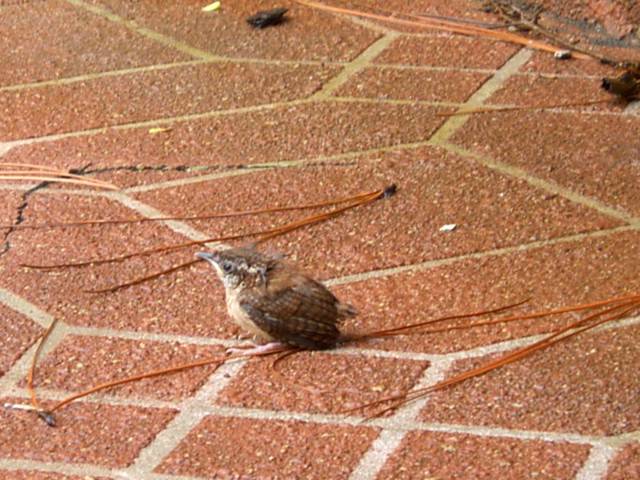
this baby bird, recently hatched in my garage, was outside for the first time last weekend. It was so adorable, I had to take some pictures. Here's one, highly zoomed in, of my little cheepy friend. he's gone now. I haven't seen any of the four chicks since they first left the nest on Monday.

Wednesday, July 07, 2004
Alive: the reflection paper part IV
The people of God were also alive and well right in our bus. Our group was an intense one—we had intense conversations, intense learning, and intense fun. As we learned about one another and our respective traditions, I could sometimes feel the ecumenical relations improving. We worked together to translate Greek inscriptions on mosaics, to remember the Hebrew we learned and turn it into something approximating modern Hebrew, to do water ballet in the Dead Sea, to climb thousands of stairs—and to get down again! I struggled quite a bit with my sense of call to Scotland—where I was supposed to go in September—and my colleagues helped me think through that and make a decision consistent with what I felt led to do. Friendships developed that could truly last—once people have traveled together they really know what their friends are like! We truly developed a Christian community: we ate together, worshipped together, worked together, traveled together, lived together, had fun together, were serious together, prayed together. We helped each other along in the hard places, shared our resources, and pined after pizza. And as we traveled these places, met people, and shared experiences we processed our thoughts and our vision, and carefully thought through some things (and the theology) we thought we knew, and many of us learned to discuss or even defend our position without getting defensive—a crucial skill for the church. Each person contributed something incredibly valuable to the whole experience for me—whether in knowledge, excitement, or personability. I spent much time wondering what I would contribute to the group, but I have realized now that it may not be the same for each person. What others contributed to my experience may not be what they contributed to my roommate’s experience, even. As a group, however, I think we learned how to be the church—the community of God’s people who live together in spite of their differences, loving one another as Christ loved us.
Sunday, July 04, 2004
Alive: the reflection paper part III
Of course, the places of worship often expressed the centuries of the faithful in several ways, as did our experiences in them. The Umayyad Mosque in Damascus has been a pilgrimage site for hundreds of years, and was one of the busiest and most active religious sites we visited. Shoeless people, many covered from head to toe (some even with their faces completely covered), walking about, praying, visiting the shrines for the heads of important people (John the Baptist and Ali both supposedly left their heads in Damascus), or just resting in the cool of the sanctuary. The church at Gethsemane has purple cross stained glass windows, amazing mosaics and a dark and somber feel echoing the events on its ground of nearly 2000 years ago and the attitude with which most people approach those events. The church I came to call the “Jesus Wept” church, with its teardrop design and the Korean group singing “What a Friend We Have in Jesus” as we arrived, and our group singing “Amazing Grace” as a few other random tourists joined us, singing as we looked out the window at the Old City of Jerusalem and the golden Dome of the Rock. The Church of St. Anne with its high ceilings, amazing acoustics, and our voices being lifted up as we sing the Doxology to the tune Old Hundredth—words billions have sung over the ages, a tune made for that space—a holy thrill. Both the Church of the Holy Sepulcher and the Church of the Nativity, witnessing to the too-old schism between churches/denominations, and also to the possibility of sharing and relationship between those of differing theological histories and worship styles. St. Katherine’s Monastery, with a mosque minaret next to its belltower, showing the world that peaceful coexistence can be more than just a dream. Each of these places gave voice to the church through the ages. They marked our way as we traveled these places we’ve read about and helped us fit ourselves into the divine-human narrative. The people of God, in every tradition, in every time, and even in every place, were especially alive for me in these spaces.
...
...
Friday, July 02, 2004
The Sea of Galilee

The Sea of Galilee, from the Gentile side looking over at the Jewish side (as they would have been in Jesus' day).
The Wilderness of Sin(ai)
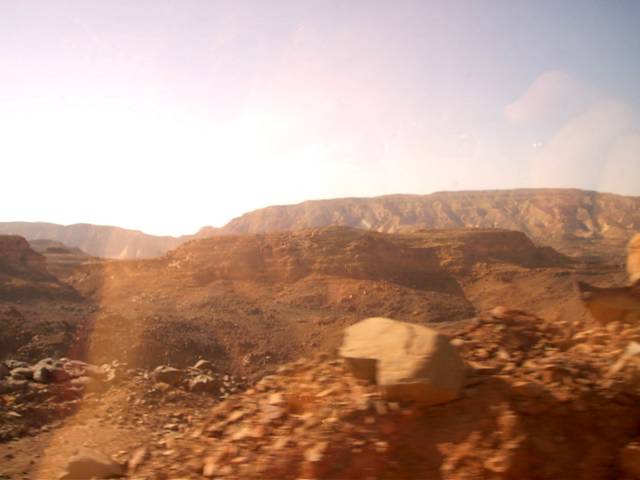
The Wilderness. As in Exodus wilderness. It was hot and all looked the same. Understand the 40 years?
Castle!
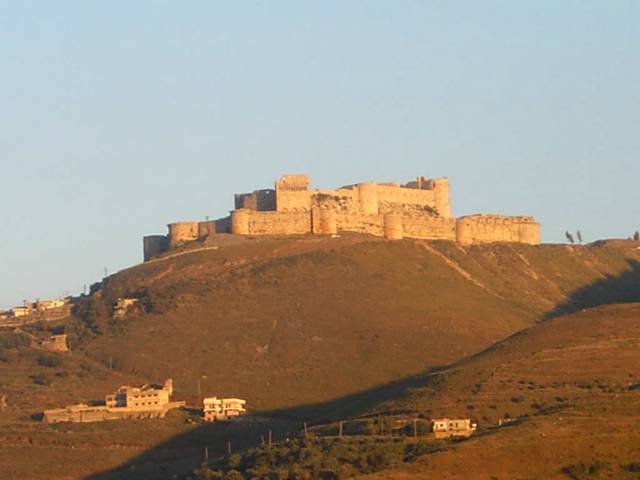
Crak de Chevaliers: a Crusader castle. The coolest Crusader castle. Here we're looking at it from my hotel room. Super super cool inside too--stables and wells and big rooms and ovens and places to pour boiling oil on invaders...yeah.
Subscribe to:
Posts (Atom)